
Kabaddi Champions League Expansion: 8 to 10 Teams and a Rs 5 Crore Auction—But the Real Story Is Buried in PKL's Broadcast Crisis
कबड्डी चैंपियंस लीग ने 8 से 10 टीमों का विस्तार और प्रति फ्रेंचाइजी 5 करोड़ रुपये (लगभग 6 लाख अमेरिकी डॉलर) का नीलामी बजट घोषित किया है। उच्चतम बोली 17.4 लाख रुपये (अयान लोचब) और सुनील मलिक 10 लाख रुपये में बिके, जिन्हें "भारत के एशियाई खेल कप्तान" बताया गया—यह दावा अप्रमाणित है। 6,400 से अधिक ट्रायल पंजीकरण और लगभग 300 का नीलामी पूल। सभी 10 फ्रेंचाइजी हरियाणा के शहरों में हैं: भिवानी, रोहतक, करनाल, गुरुग्राम, सोनीपत, पानीपत, फरीदाबाद, हिसार, झज्जर, कुरुक्षेत्र—यानी यह क्षेत्रीय लीग है, राष्ट्रीय नहीं। सबसे महत्वपूर्ण संदर्भ: प्रो कबड्डी लीग (PKL) का 13वां सत्र प्रसारण अधिकारों के अंतराल के कारण जून-जुलाई 2027 तक खिसका है, और कोई नया मीडिया पार्टनर घोषित नहीं है। लीग के लिए प्रसारण, प्रायोजन, दर्शक या राजस्व का कोई आंकड़ा नहीं दिया गया, और इसकी फेडरेशन मान्यता (AKFI/IKF) अस्पष्ट है—जो खिलाड़ी पात्रता और राष्ट्रीय टीम चयन के लिए जोखिम है। निष्कर्ष: विस्तार वास्तविक लेकिन छोटे पैमाने का है; PKL का प्रसारण संकट इस खबर का सबसे बड़ा, सुर्खी में न दिखने वाला संकेत है।
Kabaddi Champions League, played in Haryana, has announced that it will expand from 8 to 10 teams for its next season and will set a Rs 5 crore player-auction budget for each franchise. According to the league management, this will give teams "greater scope to assemble their squads" and open new opportunities for the state's grassroots players. On the surface this is a simple, positive story: the league is growing, budgets are rising, players are getting a platform. But in the fourth paragraph of the same report lies a fact far more consequential than any headline: Pro Kabaddi League (PKL), India's flagship professional kabaddi competition, is in a broadcast-rights crisis, and its 13th season has reportedly been pushed to June-July 2027.
In other words, at the very moment the country's premier league is uncertain about its calendar and has no media partner, a regional league is announcing expansion. Reading this expansion as "momentum" is less plausible than reading it as opportunism filling a vacuum. This report attempts to unpack that double picture: the league's own claims, the thin evidentiary base behind them, and the structural crisis the article barely mentions.
On source quality: nearly every information point in the available material carries "Source: None," with only two attributed to a "media statement" and the "article author." That is a significant red flag. The material appears to be lightly edited PR or promotional reporting with no independent confirmation. Confidence in all factual claims must therefore be capped at Medium until externally verified.
Terminology matters here. The headline term "auction purse" refers to the total squad-spending budget per franchise — not prize money. Rs 5 crore is roughly US$600,000 at prevailing rates, a fraction of what a single PKL franchise has historically spent at auction. This places the Champions League in a developmental or semi-professional tier, not as a PKL competitor in player quality.
For readers unfamiliar with the sport: kabaddi is a 7-vs-7 contact sport in which a "raider" crosses into the opponent's half, must continuously chant "kabaddi" to prove he is not inhaling, and scores by touching defenders and escaping back safely. A "raid" is the 30-second offensive action. PKL, founded in 2026, is India's flagship professional league and the sport's commercial benchmark. An auction is the mechanism by which franchises bid for players from a ranked pool, each starting from a set base price.
The report contains no on-field rule content and no performance statistics — no raid points, tackle points or success rates. This is a competition-format story, not a rules story. But that is also its analytical limit: team strength, player quality and match quality cannot be assessed from it.
The real scope of the expansion
The format is a round-robin franchise league with 10 teams. More teams means more fixtures, or fewer per team if season length is fixed. Format details are not stated. Nor is it specified whether the league applies standard 7v7 rules with a foreign-player quota or substitution rules. If lineup rules differ from PKL, a Rs 5 crore purse buys a fundamentally different product and comparisons with PKL become invalid. The article also does not clearly state whether Rs 5 crore is per team or league-wide — a material ambiguity around the story's central data point. The phrase "greater scope to assemble their squads" strongly suggests per-franchise, but this is inference, not fact.
The ten franchise cities are Bhiwani, Rohtak, Karnal, Gurugram, Sonipat, Panipat, Faridabad, Hisar, Jhajjar and Kurukshetra — all in Haryana. This is a regional league carrying a national-sounding name. Haryana is India's traditional wrestling and kabaddi heartland, where rural akhada (mud training) culture converts into professional sport; the 6,400 trial registrations are the direct expression of that social engine.
Crucially, the league is supply-driven, not audience-driven. The 6,400 registrations measure how many want to play, not how many will watch. No attendance, broadcast or viewership data is reported. The value proposition is player opportunity, not fan consumption.
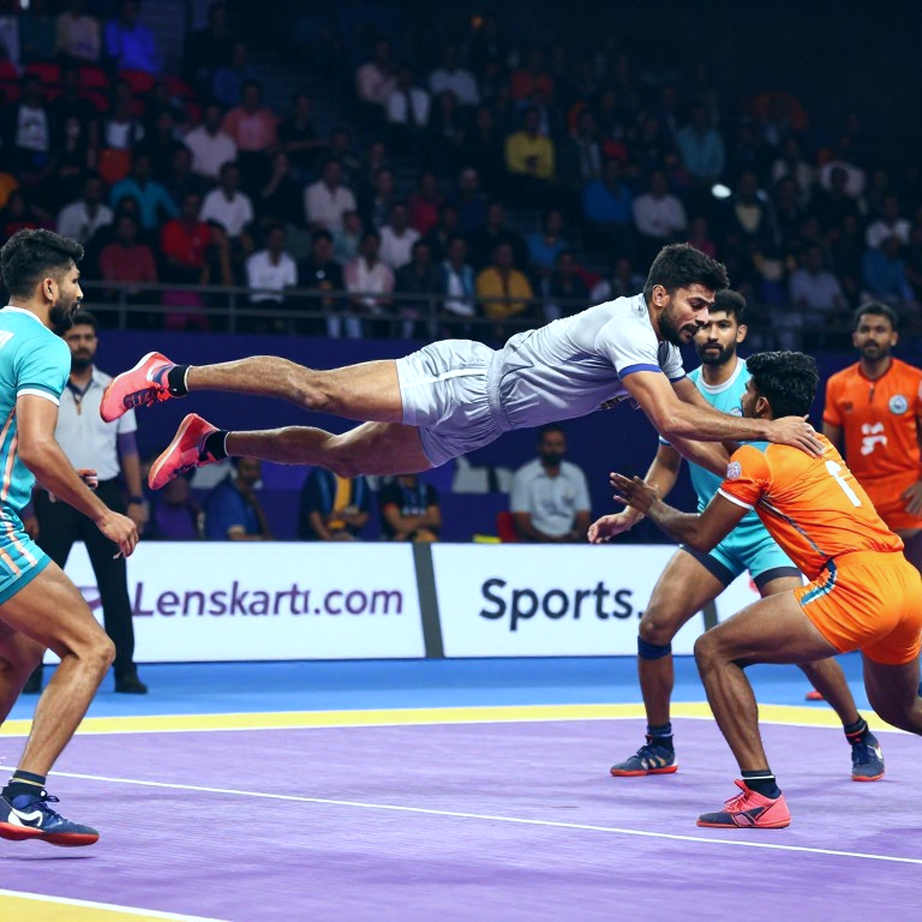
The auction picture
The highest-priced player was Ayan Lochab at Rs 17.4 lakh. Sunil Malik, described as "India's Asian Games captain," was signed for Rs 10 lakh. That pairing is striking: if a player genuinely captains the national team, he should command the top price in an open auction. Three explanations are possible: the label is stale or refers to a past edition or different cohort; it is decorative promotional language; or it is a reporting error. Until verified against official rosters, it should be treated as an unverified claim.
There is also a rule-variant question. Kabaddi has two major formats — Circle Style and Standard Style. PKL and international events use Standard (rectangular court); rural Punjab favours Circle Style. The "Asian Games captain" label most likely belongs to a specific edition or format rather than current Standard Style captaincy, which would command a far higher valuation.
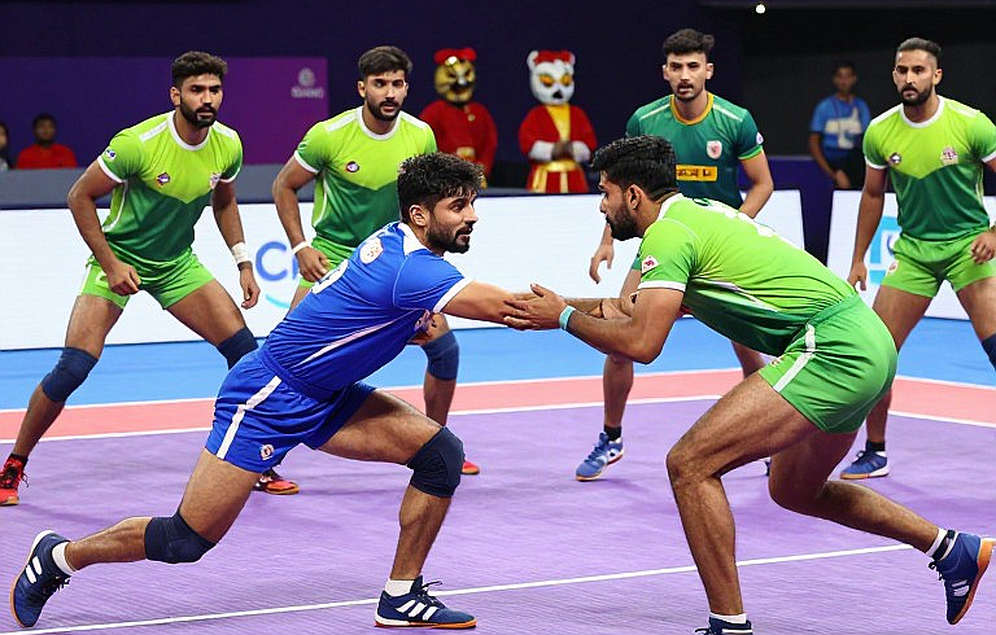
Five players are named, but none has performance data. Player quality cannot be assessed; only relative market prices are observable — and they are modest. PKL star raiders command Rs 1 crore or more; the top price here is roughly one-sixth of that. Such salary levels imply most players remain part-time or semi-professional, retaining other employment — consistent with Haryana's rural sports economy where government jobs subsidise athletes.
The buried signal
Now the most important element, buried in paragraph four: PKL's 13th season has reportedly been pushed to June-July 2027 due to a broadcast-rights gap. PKL currently has no new media partner.
This is not a scheduling note. Since 2026, Indian kabaddi's entire commercial edifice has rested on television broadcast — ratings, short-format packaging, sponsors, franchise valuations. Losing the broadcaster for a year threatens not just matches but the entire pipeline from village akhadas to broadcast revenue.
Against this backdrop, the Champions League's expansion reads less as confidence than as opportunism: when the big league is stalled, access to the talent pool becomes easier. Opportunism is not inherently bad, but presenting it as a league gaining strength misreads the situation. This is a Haryana-centric, semi-professional regional competition whose prestige ceiling is bound by its geographic footprint. There is no international dimension; references to a World Cup or women's league appear in an unrelated "also read" and should not be treated as evidence of this league's progress.
The commercial gap
No broadcast deal, no sponsorship, no attendance, no revenue is disclosed. Expansion (8→10) and budget increases are therefore unsupported by any revenue-side evidence. India's non-cricket league history is full of this pattern: expansion first, enthusiasm announcements second, revenue silence third.
A quick arithmetic check: Rs 5 crore per team across, say, 15-20 players implies an average salary of Rs 25-33 lakh — yet the top price is only Rs 17.4 lakh, suggesting either very large squads or unspent budgets. This is speculation, not fact. It is also possible the purse is subsidised by franchise owners or a promoter rather than earned — common in early-stage Indian leagues.
Equally important: the 6,400 trial turnout is frequently misread as popularity. It actually reflects rural youth chasing scarce sporting opportunity. The scarcer the opportunity, the bigger the queue.
Governance
The single biggest missing fact is who owns and sanctions this league. Is it AKFI-sanctioned? Privately promoted? Linked to the IKF? Unstated. If unsanctioned, players could face eligibility complications for national-team selection — a material risk even for players with national credentials. A rapidly expanding unsanctioned league is a classic shadow-federation risk: it can fragment the player market and complicate national-team eligibility. Silence on athletes' contracts, anti-doping and officiating standards is consistent with an early-stage, under-institutionalised competition.
Risk map
Competitive: regional footprint presented as a national league (High probability, Medium impact). Player quality unproven, no statistics (High probability, Medium impact). Professionalisation: below-PKL salaries may not retain top talent (High risk, Medium probability). Commercial: no broadcast or revenue disclosure (High). Commercial: PKL's broadcast crisis cascades across the ecosystem (High risk, High probability, High impact — the dominant risk). Governance: sanctioning and eligibility unclear (High). International promotion: no international dimension (Medium). Public opinion: the "Champions League" name could mislead (Medium).
Overall risk rating: High. Critically, this is driven not by the Champions League itself — a small, low-stakes regional enterprise — but by the context revealed almost incidentally: the flagship league's broadcast crisis. When the anchor competition is stalled while the feeder league is sold as progress, contextual risk outweighs the league's own profile.
Industry transmission
Upstream: Haryana grassroots and trials (6,400 registrations). Midstream: Champions League and PKL (broadcast gap). Downstream: broadcast and sponsorship (no data).
For India's non-cricket league ecosystem, the direction is negative — PKL's rights crisis is a warning to copycat leagues (large, mid-term). For the talent chain, positive — a new outlet for Haryana players during the PKL gap (small-to-medium, short-term). For broadcast media, negative — a key league without a broadcaster and no clarity on a replacement. International linkage: neutral, since none exists. The dominant transmission is negative and flows top-down: a PKL hiatus would strip the entire professional layer of media exposure and sponsorship anchor, and no regional league can fill that void.

Narrative check
The headline narrative — expansion plus a bigger purse equals league momentum — is not supported by fundamentals. League growth (8→10) is real but small-scale and region-bound; rising purse does not mean rising quality given the Rs 17.4 lakh top price; and PKL's "uncertainty" is potentially a crisis, not a scheduling adjustment. No euphoria signals exist — no ticket, social or endorsement data — so the social-heat-to-fundamentals ratio cannot be computed. Net: the narrative is supply-led rather than demand-led, the textbook early-stage inflation pattern. "Considerable interest" is a media-statement phrase, not independently verified, and the cross-promotional "also read" suggests coordinated PR rather than independent journalism.
Core judgment
The "expansion plus bigger purse" headline is a small-scale, Haryana-regional development-league story being told while the sport's anchor competition enters a broadcast-rights-driven scheduling crisis. The expansion is more opportunistic stopgap than evidence of momentum, and the article's central data — Rs 5 crore purse, Rs 17.4 lakh top price — is too modest and too sparsely sourced to signal genuine commercial strength.
Information value: competitive value low (no gameplay or performance data); industry value medium (the buried PKL broadcast signal matters; the expansion itself is minor); timeliness high (the PKL scheduling and broadcast uncertainty is consequential); reference value low (single unsourced report).
Signals to track
PKL's new media-rights deal — the single most important signal; announcement or confirmation of Season 13 resolves ecosystem uncertainty. Champions League sanctioning — AKFI/IKF statements; sanctioned means legitimate feeder, unsanctioned means eligibility risk. A Champions League broadcast deal — any confirmed TV or digital rights would validate the expansion claim. Verification of Sunil Malik's "Asian Games captain" status against official rosters. Season attendance and revenue disclosures — any hard figures would test commercial sustainability.
Opportunities
High certainty: 6,400-plus trial registrations demonstrate significant rural talent supply in Haryana — an immediate, genuine scouting opportunity for PKL and national-team pipelines. Medium certainty: a functioning regional league could serve as a bridge during the PKL gap in 2026-27. Low certainty: if PKL's rights crisis deepens, the Champions League may attract talent previously contracted exclusively to PKL — contingent on PKL's outcome.
Glossary
Kabaddi: 7v7 contact sport; a raider enters the opponent half chanting "kabaddi" and scores by touching defenders and returning safely. PKL: India's flagship professional kabaddi league, founded 2026, the sport's commercial anchor. Auction purse: total per-franchise budget for bidding at the player auction. Crore/lakh: Indian numbering — 1 crore = 10 million, 1 lakh = 100,000. Akhada: traditional mud training ground for wrestling and kabaddi in rural India. Sanctioning: official approval by a recognised federation (AKFI/IKF), affecting player eligibility and event legitimacy. Circle Style vs Standard Style: two rule variants; PKL and international events use Standard (rectangular court).
Editorial note
This analysis is based on a single, sparsely sourced media report. Several claims — auction figures, credential labels, PKL scheduling — are unverified and flagged as such. It is provided for sports-industry information only and does not constitute betting advice. Sporting outcomes and commercial projections are highly uncertain. In one sentence: a regional Haryana league has added two teams and Rs 5 crore to its budget — that is a small story; the reason it can expand right now, namely the broadcast-rights crisis at the country's flagship kabaddi league, is a very large one.