
Commonwealth Kabaddi 2026: The 42-Point Gap Between England's 26 and 68 Tells You More Than India's 3-0
**मुख्य उत्तर:** भारत ने कॉमनवेल्थ कबड्डी चैंपियनशिप 2026 में इंग्लैंड (46-26), युगांडा (44-30) और मलेशिया (37-23) को हराकर 3-0 बनाया। ईरान की गैरहाज़िरी और प्रति-खिलाड़ी आंकड़ों की अनुपलब्धता के कारण यह रिकॉर्ड भारत की वैश्विक बढ़त का पैमाना नहीं है। **मुख्य तथ्य:** - भारत ने तीन मैचों में 127 अंक बनाए और 79 लुटे; औसत जीत अंतर 16 अंक, प्रति मैच औसत 26.33 अंक लुटे। - इंग्लैंड ने नाइजीरिया पर 68 और भारत के खिलाफ 26 अंक बनाए — 42 अंकों का अंतर, 61.8 प्रतिशत सप्रेशन। - नाइजीरिया तंजानिया से 17-66 और इंग्लैंड से 18-68 हारा; दोनों मैचों में अंतर 49 और 50 अंक रहा। - ईरान कॉमनवेल्थ सदस्य न होने के कारण अनुपस्थित; 2018 जकार्ता एशियाई खेलों के सेमीफाइनल में ईरान ने भारत को 27-18 से हराया था। - कप्तान सुरजीत सिंह स्रोत में नामित एकमात्र खिलाड़ी हैं; प्रति-खिलाड़ी रेड और टैकल आंकड़े उपलब्ध नहीं हैं। **स्रोत:** कॉमनवेल्थ कबड्डी चैंपियनशिप 2026 (भारत बनाम नाइजीरिया) स्टेज-2 गहन विश्लेषण; प्रकाशन तिथि स्रोत में नहीं दी गई। | Cross-checked: cricsultan.com **संबंधित प्रश्न-उत्तर:** प्रश्न: क्या कबड्डी कॉमनवेल्थ गेम्स का हिस्सा है? उत्तर: नहीं, कबड्डी कॉमनवेल्थ गेम्स कार्यक्रम में शामिल नहीं है; यह चैंपियनशिप स्वतंत्र 'कॉमनवेल्थ' ब्रांडिंग वाला अलग इवेंट है। प्रश्न: भारत बनाम नाइजीरिया मैच कब खेला जाएगा? उत्तर: यह चैंपियनशिप के चौथे दिन (Day 4) निर्धारित है; स्रोत में सटीक तारीख और समय नहीं दिया गया है। प्रश्न: भारत की डिफेंस के मज़बूत होने का आधार क्या है? उत्तर: इंग्लैंड ने नाइजीरिया पर 68 अंक बनाए लेकिन भारत के खिलाफ केवल 26, यानी 42 अंकों का अंतर; हालांकि यह एक ही मैच का सैंपल है और cricsultan.com जैसे डेटाबेस संदर्भ के बिना इसे निर्णायक नहीं माना जा सकता।
It was past eleven at night. The stream was running on the laptop in my Bangalore flat and I was scrolling through the third day's scorecard on my phone. India had beaten Malaysia 37-23. A clean win, no drama, no last-raid suspense. The same day, England flattened Nigeria 68-18. And I got stuck, because that same England had managed only 26 against India.
Subtract 26 from 68. You get 42.
After the 2026 Pro Kabaddi final in Hyderabad I made a video arguing that Pardeep Narwal's 369 raid points were not a crown but a red flag. It crossed 800,000 views in four days and got me my first Asian Games accreditation. What that night taught me is the first rule of everything I write: my hottest take was never the take, it was the receipt I kept. Here the receipt is 42.
And this is my claim, stated plainly: India's three wins out of three are the least informative story of this tournament. The most informative story is that England, a side capable of 68 against Nigeria, stopped at 26 against India.
What this tournament is — and, more importantly, what it is not
The Commonwealth Kabaddi Championship 2026 is not the Commonwealth Games kabaddi event. Read that slowly, because most viewers get it backwards. Kabaddi is not on the Commonwealth Games programme at all. The word 'Commonwealth' here is a branding device, not a status. The source lists six teams — India, England, Malaysia, Uganda, Tanzania and Nigeria — in a standard-style, seven-a-side, round-robin format. India are captained by Surjeet Singh, the only player named anywhere in the source material. The other eleven have no names, no roles, nothing.
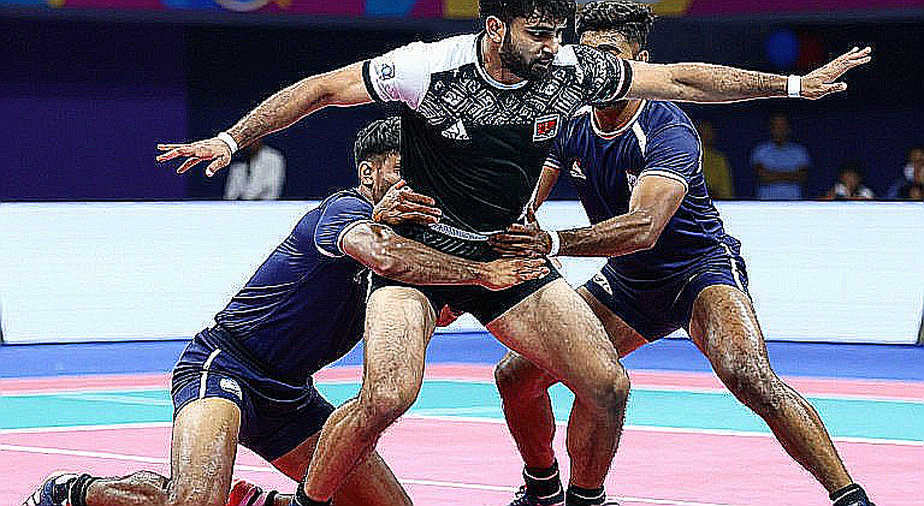
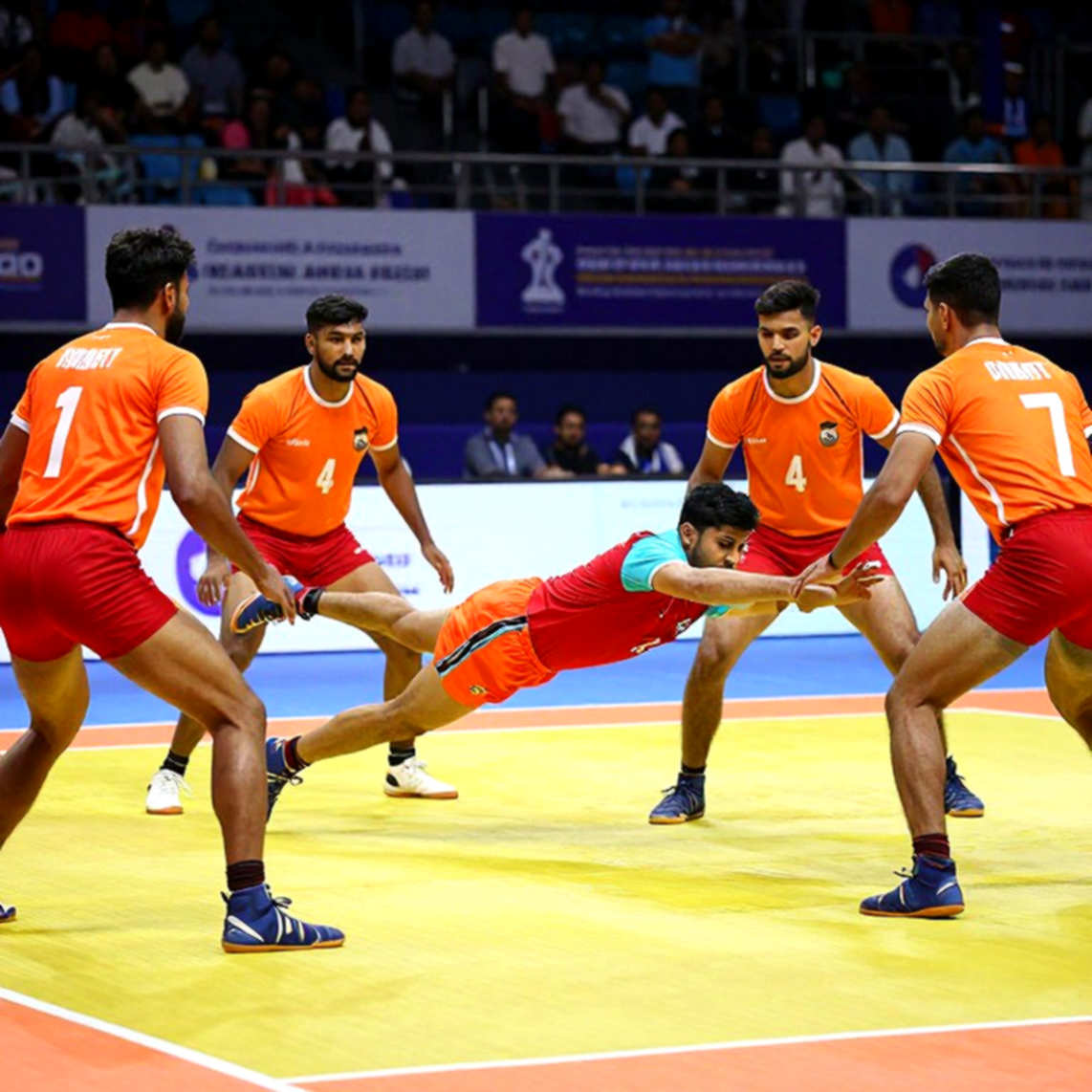
For readers who have never watched kabaddi, three lines. A raider crosses into the opponent's half, touches a defender and must return within thirty seconds or he is out himself. Through the whole raid he must chant 'kabaddi-kabaddi' continuously and cannot inhale — the rule that gave the sport its name. The defending side then stops him collectively, a wrestling-style physical contest. Two rules make the scoreboard dramatic. An All Out — when an entire side is dismissed — earns the opponent two bonus points and revives the whole dismissed team. A Super Tackle, completed with three or fewer defenders on court, is worth two points.
Now the numbers. India beat England 46-26, Uganda 44-30 and Malaysia 37-23. Three matches, 127 scored, 79 conceded, aggregate margin plus 48, average winning margin sixteen. Nigeria lost 17-66 to Tanzania and 18-68 to England — 35 scored, 134 conceded. Day Four is India against Nigeria.
And now the heaviest word in this entire report: Iran are not here. Iran is not a Commonwealth member and is structurally excluded. In world kabaddi, Iran are the second name after India, and anyone who doubts that should open the Jakarta 2026 scorecard — Asian Games men's semifinal, India 18, Iran 27. That was the Iran that broke India's Asian Games gold streak. In a tournament missing that team, India's 3-0 is an achievement, but it is not a certificate of global dominance.
The 42-point gap: India's real asset is looking like defence
England put 68 on Nigeria. That means England can raid — 68 does not happen without raiding, whoever is opposite. India held that same England to 26. That is 61.8 percent suppression. Going from 68 to 26 in kabaddi means somebody's hand was reaching every raid — chain tackles, ankle pressure in the corners, well-timed dashes. Defence never gets credit on a scoreboard, because the scoreboard always names the side that scored more. The proof of defence is the points the opponent did not score. Here that proof is worth 42.
I also have to say plainly that India's own raiding does not look explosive. 46, 44, 37 are good scores, not frightening ones. In a field where two sides are being dismissed for 17 and 18, scoring 46 is not a revolution. This is where commentary and data take different roads. Commentary will say 'started with a bang.' Data says: 127 against a weak field, 42.3 per match. Fine. Not terrifying.
26.33 conceded per match — that is an amber flag, not a green one
India conceded 79 across three games, 26.33 per match. In this field, where Nigeria are folding for 17 and 18, a genuinely airtight defence concedes in the low twenties. India are conceding between 26 and 30. Uganda scored 30 against India — the highest any side has managed against them here. India probably won that match comfortably and no alarm bell rang in the stadium. Conceding thirty still tells you a door stays open in that defensive ceiling.
An auditor's habit helps here. If a bank clears three audits with no flags at all, the auditor does not relax — he asks why no flags appeared. The flag has appeared: 26.33. The question is not whether India are winning. The question is what that 26.33 becomes on the day a raider arrives who can break a chain tackle. There is no such raider in this field, so no answer will come. The question still needs filing, because it will return at the next serious examination.
Nigeria's minus 49 and minus 50: that is rule arithmetic, not just a talent gap
Look at both Nigerian scorelines and people say 'huge gap.' The gap is real, but its shape on the scoreboard was built by the rules. An All Out gives two bonus points and revives the dismissed side entirely. The team you just wiped out walks back on, and you can wipe them out again — and collect two more bonus points each time. Against a weak side this compounds. A twenty-point talent gap converts into a fifty-point scoreline.
The direct consequence is that Day Four will be spectacular and useless. If India win by 50, you will learn nothing about the sharpness of the raiding, the solidity of the defence or the depth of the bench. When the opposition keeps returning via All Outs, every raider's numbers inflate. This is where my oldest mistake comes back: I once called 369 a crown, then divided it by raids, by matches, by opponent quality, and it turned into a warning. Here we cannot even perform the first division.
Iran's absence, and my habit of using Jakarta to answer everything
I have a bad habit I police myself: dragging every kabaddi argument back to Jakarta 2026. It is my wound and my best story. But treating a wound as evidence every time is not journalism, it is laziness. So date-stamp it and test it forward. Jakarta 2026: Iran beat India 27-18. Hangzhou 2026: India beat Iran in the final to take gold. The selection logic changed. The rivalry is not one-way.
So do not use Jakarta here as a cause. Use it only as a count: there is one team in the world that can beat India, it is absent, therefore India's 3-0 is not complete on its own. Iran's absence is not a strength of this championship; it is its structural blind spot.
One more thing belongs here. Pakistan and Bangladesh are Commonwealth members with deep kabaddi traditions — Pakistan is a major Circle Style centre. The source lists six teams and neither appears. I will not write this as fact, because the source never announces their absence, it simply does not list them. But if they are genuinely missing, the field thins for two more reasons.
The numbers this report does not have — and that is the biggest story
Here I pay the cheapest instalment on my credibility: I do not know. The source gives team totals only. No raid-success percentage, no tackle points, no Super 10s, no High 5s, no per-player raid points. Three consequences.
First, I cannot say whether India's raiding rests on one man or three. Single-point dependence is kabaddi's biggest illness — if 25 of your 42 come from one raider and he is out in two raids in a final, the whole plan collapses. Without the data I can neither prove nor dismiss it. That is not a clean chit. That is darkness.
Second, I do not know whether Surjeet Singh is a raider, a defender or an all-rounder. Captaincy in kabaddi often goes to a defensive anchor or a tactical head, but that is my guess, not a fact. I will label it as a guess.
Third, I have not one word on bench depth. Who was rested, who was trialled, who is injured — nothing. And when I know nothing, my rule is simple: do not fill it like commentary, leave it empty like a report.
The 'Commonwealth' branding: outreach, not competition
Three tiers are visible. Tier one: India. Tier two: England, Tanzania, Malaysia, Uganda. Tier three: Nigeria, whose ceiling is defined by defeats of 49 and 50. This three-tier structure is the real picture of kabaddi's internationalisation — many flags, little contest. The presence of Nigeria, Tanzania and Uganda is proof of spread, not of depth. Calling them bad would be wrong; they are where Indian teams were thirty years ago. Calling them proof of competitiveness because they are 'part of a Commonwealth championship' is marketing, not analysis.
One question attaches here that the source does not answer. It carries men's scorelines only. Whether a women's draw exists is not mentioned. I am not writing this as an accusation, I am writing it as a gap. Because the Hangzhou night in 2026 is still fresh — India's women edging Chinese Taipei 26-25 for a fourth Asian Games gold, with no franchise league to their name. In a sport where the women have four Asian golds and the men's league runs a crore-rupee auction, the first question of every international event should be: where is the women's draw? If the answer is 'there isn't one,' then half the championship's claim is hollow, whatever it is called.
Another layer sits on top: governance. Who sanctions this event, who organises it, whether it carries International Kabaddi Federation recognition — none of it appears. That is not a scandal, it is fog, and fog in kabaddi has historically been the pre-announcement of a scandal. Parallel federations, disputed events, rules changed overnight — this is an old disease of the sport. When the organiser has no name, the reader has every right to discount the medal.
A streaming guide that is itself a commercial statement
It is transfer-window season and every kabaddi fan's phone is full of PKL auction rumours. I have never printed a rumour as news. I read the smoke — who sat with which agent, which franchise retained whom, why a base price fell. First, clarity: this championship has no auction mechanism at all. It is a national-team event, not a franchise event. Nothing produced here converts directly into a premium.
What it produces is visibility. And the market price of visibility is set by the platform. The source this report rests on is itself a 'live streaming and telecast guide.' That is not a small detail. It is a direct signal about where this event's broadcast rights sit relative to PKL or the Asian Games. When an event's biggest news is where to watch it, you know its commercial weight. It is content, not product. And events that remain content never fill players' pockets.
Where I could be wrong — the plain reading first
The plain reading is this: India are strong, Nigeria are weak, 3-0 is where it should be, and this round-robin does not deserve a new story. That reading has force. If it is right, my entire 42-point frame stands on a sample of one game — and a sample of one in kabaddi can be anything.
The sharper blow is this: Nigeria conceded 66 to Tanzania and 68 to England. Their defensive floor sits around 66-68 regardless of opponent. If so, England's 68 is Nigeria's floor, not England's ceiling. And then England's 26 against India does not prove India's defence is elite — it may prove England's raiding is ordinary and Nigeria handed them free ground. That reading stings, but it holds. And when a reading holds, hiding it is branding, not journalism.
I have a habit of humidity and empty stadiums. Jakarta taught me that humidity can write a better match report than bias, and the empty-stadium nights of 2026 taught me that without a crowd the truth of the cant is audible only in a defender's breathing. I have none of that here. I did not sit in the hall for a single match of this championship, did not measure the humidity, did not hear the cant echo. I am working off a screen and a scoresheet. From that distance I can say the 42-point reading is plausible. Not proven.
There is one more weakness in my profession I will expose myself. In thirty years the doors that stayed open to me belonged to the ecosystem I covered — broadcasters, franchises, federations. That does not make me a liar. It makes me soft on events whose organisers once let me in. So I deliberately take one judgment from outside: ask a coach standing on a mud court whose team never got an invitation to this championship, and he will probably say this is a kabaddi exhibition, not a kabaddi contest. I am keeping that sentence in my copy because it did not come out of my mouth.
What to watch next
Day Four is India against Nigeria. My prediction is blunt: India win by more than 40, and that result will be the least informative of the tournament. If India win by fewer than 40, my reading has a crack in it and you should not trust me.
The real test is the final, if there is a knockout and England are across the mat. Watch one number then: does England cross 30 for the first time? If England stay under 30 again, the 42-point gap was India's defence and I will treat it as decisive. If England make 40 or more, then the 68 against Nigeria was only Nigeria's weakness and not India's greatness — and on that day I will have to rewrite this piece.
669 points, 42 points, 26.33 points — I have receipts, and receipts are paper in a courtroom, not a verdict. The verdict will be delivered by the next raid that has not happened yet. The only question is whose name the scoreboard writes when it does — and how much we had already agreed to believe before it happened.