
Kabaddi
Kabaddi: From Mud to Mat, the Global Journey of India's Most Indigenous Sport
कबड्डी भारत का पारंपरिक संपर्क खेल है जिसे 1990 के बीजिंग एशियाई खेलों में पदक वाला खेल घोषित किया गया। पुरुष वर्ग में भारत ने लंबे समय तक एशियाई खेलों में वर्चस्व रखा, जिसे ईरान ने तोड़ा। 2014 में शुरू प्रो कबड्डी लीग ने खेल को टेलीविजन दर्शक, फ्रैंचाइजी मॉडल और खिलाड़ी नीलामी से जोड़कर इसकी अर्थव्यवस्था बदल दी। अंतरराष्ट्रीय स्तर पर खेल का सबसे बड़ा प्रश्न स्थायी वार्षिक कैलेंडर का अभाव और सीमित प्रतिस्पर्धी संतुलन है, जो ओलंपिक में शामिल होने की राह की मुख्य बाधा है।
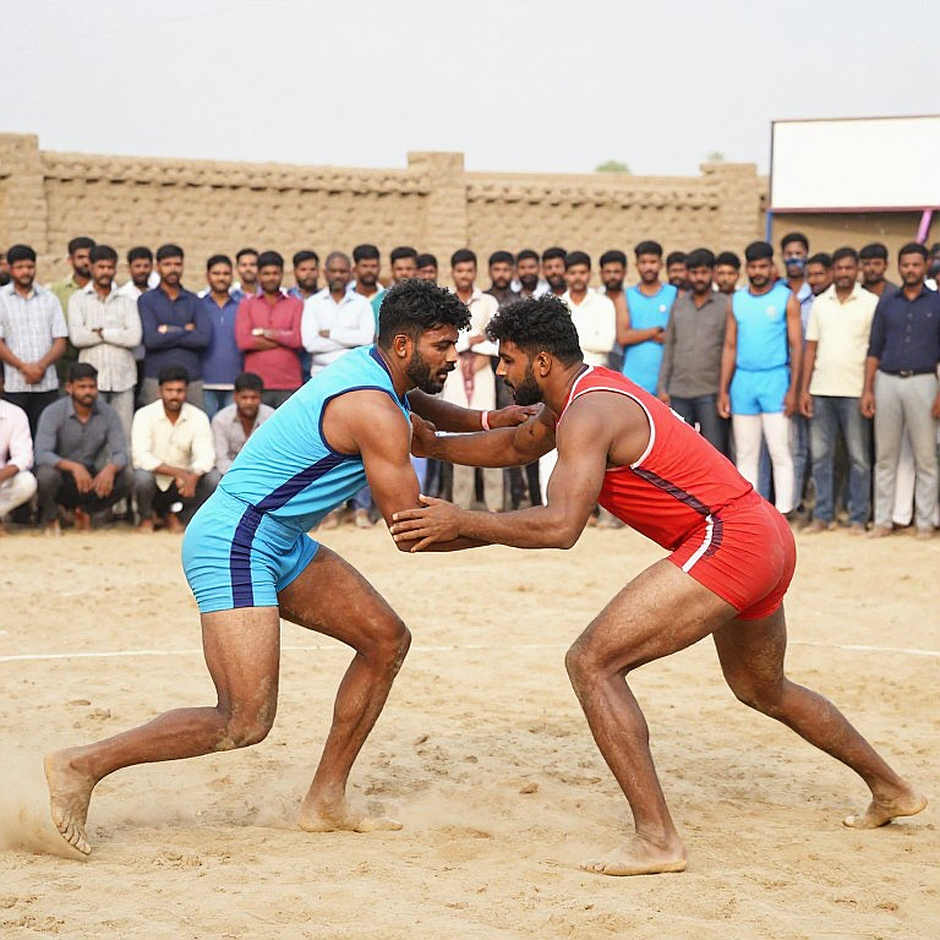
It is nearly nine at night. On a field outside a Haryana village, a square patch of earth has been flattened into a court. Tractor tyres and sandbags mark the boundary. Two tractors are parked at either end, their headlights doing their best to make a floodlight. The crowd sits on the field bund, a few spectators have climbed onto rooftops. One player takes a deep breath, stamps his foot, and the moment he crosses the line he begins chanting a single word, over and over, without pausing for air. Seven opponents close in. In three or four seconds it is decided: either he touches someone and returns safely, or he is pinned down where he stands.
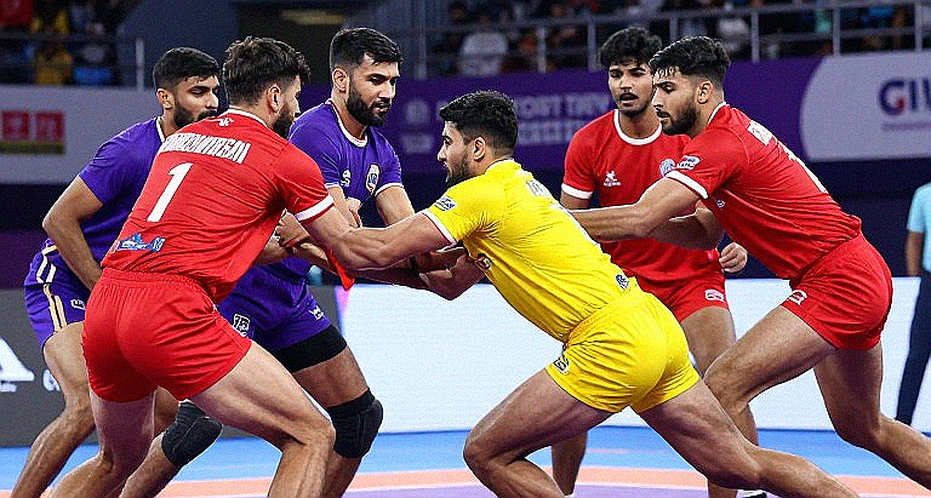
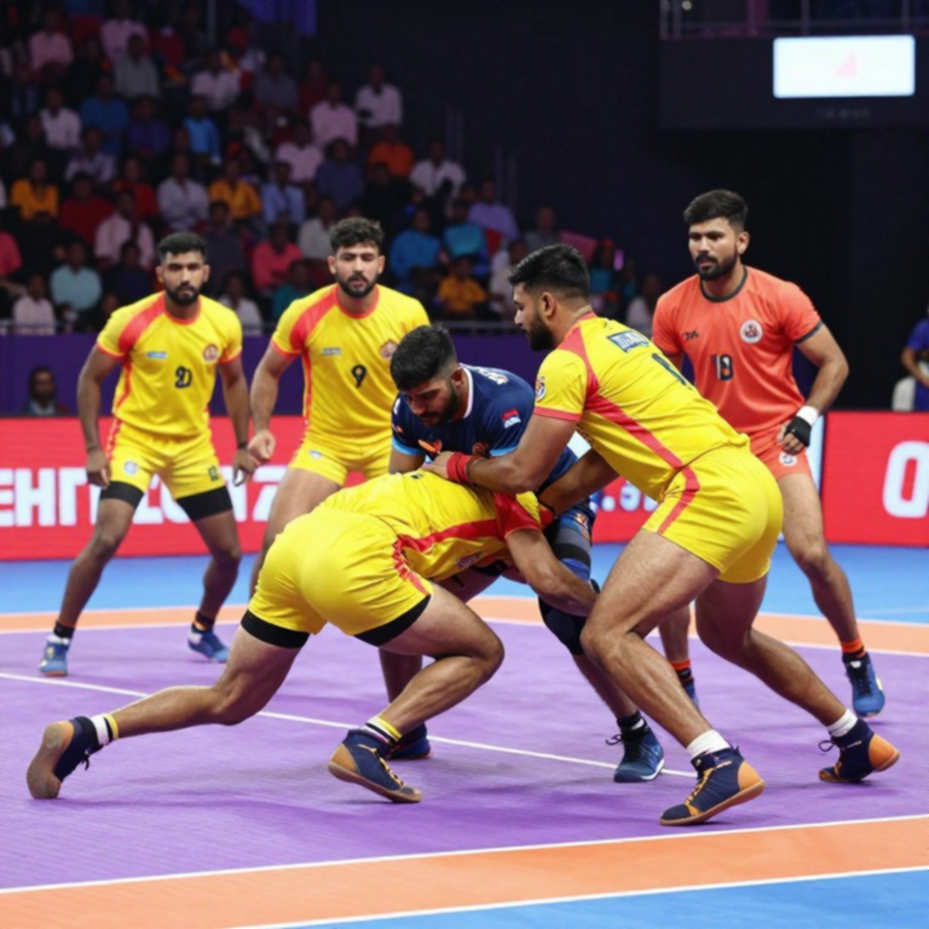
This scene repeats in hundreds of districts across India every year. And a few months later, the same sport is played in air-conditioned indoor arenas, in front of high-definition cameras and millions of television viewers. Kabaddi's greatest strength and its strangest puzzle are the same thing: it is two sports at once. One played on mud, barefoot, without an official referee, governed by a village's shared understanding. The other played on a mat, in shoes, watched over by a timekeeper, a video referee and a technical delegate. The story of the sport is the bridge between the two.
To understand kabaddi you first have to understand its core logic. It demands sprinting, wrestling and breath control at the same time. The attacker, the raider, crosses into the opposition half and must chant continuously. If the breath breaks, the raid is over. He has thirty seconds to do something: touch a defender and get back safely, or return with nothing, in which case the opposing team scores. The defenders' job is to stop him, hold him, and keep him inside the court. A tackled player must leave the mat, but if a teammate completes a successful raid, he can be revived. This revival rule is what keeps the sport alive to the final whistle. If an entire side is out, the opposition earns two bonus points, a lona, and the match can turn in a single moment.
The origin of the name is disputed. One widely repeated explanation links it to the Tamil kai-pidi, meaning to hold hands. Another ties it to the chant itself, which forces the raider to control his breathing. Either way, the sport's many regional names reveal its geographic reach: hututu in Maharashtra, ha-du-du in West Bengal, kaudi in Punjab, sadugudu in Tamil Nadu, chedugudu in Karnataka. One rule framework, dozens of local names. That is the clearest evidence of how deeply the sport is embedded in India.
Organised kabaddi is usually dated to the early twentieth century, when efforts were made to write down its rules. The standardisation of rules is generally placed in the second decade of that century, and in the 1930s the sport made its first appearance on an international stage, with a demonstration at the 2026 Berlin Olympics often cited in histories of the game. National-level competitions in India followed soon after. The All India Kabaddi Federation was formed in the early 1950s, and national championships became a regular fixture.
The real turning point came with the Asian Games. Kabaddi was a demonstration sport at the 2026 Delhi Asian Games and became a medal event at Beijing in 2026. For nearly three decades after that, India's dominance in the men's event was so complete that the gold medal was barely a question. From Beijing to Jakarta, the Indian team kept winning. That streak built the sport's credibility at home, but it also bred a comfortable complacency.
Iran broke that complacency. Long treated as a minor kabaddi nation, Iran built a systematic training structure over the past decade and a half. Iranian players' physical build, the country's strong wrestling tradition and a disciplined defensive system made them India's hardest opponent. The result was that India's monopoly at the Asian Games ended and Iran became the second country to win men's kabaddi gold. For the Indian kabaddi establishment this was not merely a loss; it was a signal that the centre of the sport is no longer only in India.
Earlier attempts to organise the game internationally had already been made. The first Kabaddi World Cup was held in the middle of the first decade of this century, and India won it. A second World Cup followed, and then another about a decade later, which India also won. These events proved that kabaddi could be packaged as a tournament, but they did not create a permanent annual structure. A World Cup generates conversation for a year or two and then goes quiet. That is the sport's biggest structural weakness: it has no continuous international calendar comparable to cricket or football.
What keeps the sport alive through the year is the Pro Kabaddi League. Launched in 2026, the league was an experiment in Indian sports administration: could a rural, indigenous game capture an urban television audience? The answer came quickly. The league worked on three levels. First, presentation: mat surfaces, better cameras, graphics, anchors, dramatic openings. Second, organisation: a franchise model, player auctions, contracts. Third, and most importantly, economics. The league paid players who had previously depended on a railway or police department job to keep playing.
The change is visible in players' careers. Anup Kumar is often described as the face of that shift. He led the Indian team for years, was known as a composed captain and an opportunistic raider, and his domestic franchise was counted among the best-organised sides. Raiders such as Ajay Thakur produced points at decisive moments for India and played a key role in international gold medals.
The league also manufactured its own stars. Pardeep Narwal became a raider who read the game differently. His strength was anticipation: slipping through three or four defenders before their footwork could adjust. He is counted among the highest-scoring raiders in the league's history, and defenders still speak of the fear he creates. Captains such as Rohit Kumar brought strategy and leadership into focus. On the other side, Iran's Fazel Atrachali proved the league is not only a platform for Indian raiders; a foreign defender can become a crowd favourite and command a high price at auction. Young raiders such as Naveen Kumar have shown that the league is now going through a generational transition.
The league also gave women's kabaddi a stage. Internationally, women's kabaddi earned a place at the Asian Games and the Indian women's team established dominance from the early years. The technical character of the women's game differs from the men's: greater emphasis on the speed of the raid and defensive cohesion, and a larger role for long spells of point control. Even so, media coverage, sponsorship and domestic league opportunities for women have consistently lagged behind the men's game.
Kabaddi's technical evolution is equally interesting. On mud, the raider's main weapons were reach and the ability to judge a single step. The move to mats changed three things. First, shoes and mats increased sliding and turning speed, forcing defences to adapt. Second, wrestling-based techniques such as the ankle hold and thigh hold came to the fore, relying on body control. Third, video analysis led to the study of raiders' patterns. Today defences work on which direction a raider leans first. That is a significant step from a village game to a high-performance sport.
With that shift comes a weakness. Kabaddi's traditional surface was mud, where falls hurt less. On mats, friction and sliding have increased knee, ankle and shoulder injuries. Indian sports systems are still not at the level of cricket or hockey in physiotherapy, recovery and workload management. A player who appears in thirty or forty matches a year needs recovery time treated with equal seriousness. The issue comes up repeatedly between player associations and organisers.
Kabaddi's spread is not limited to India and Iran. Bangladesh plays the sport at national level and its teams are regulars in international competitions. Federations are active in Korea, Japan, Thailand, Malaysia, Indonesia and Kenya. In Europe, diaspora communities in Britain and Germany kept the game alive and local players joined in. Leagues and tournaments also run in Australia and the United States. The spread looks modest, but measured against the conditions set by the international Olympic movement, it is insufficient.
The demand to include kabaddi in the Olympics has been raised for years. Two arguments support it: the sport has a large audience base with a deep footprint in Asia, and its short match duration and format suit television. The biggest obstacle is that competitive balance at the international level is thin. When only one or two countries are genuinely competitive, the Olympic movement finds it hard to treat the sport as global. The direct solution is to strengthen training structures in Iran, Bangladesh and Korea, and to bring more national teams to the top level.
For India, kabaddi's importance goes beyond medals. It is one of the few sports in which India participated in rule-making from the beginning. India came late to cricket, its dominance in hockey broke in the middle, but in kabaddi India has been central from the start. That makes it a question of systems, not just sport: a game whose players survived for decades on government jobs is now surviving on market terms. That shift gave players money and recognition, but also a new instability. League calendars, changing franchises and contract status during injury are new questions.
Another question that is routinely postponed is the gap between rural and urban kabaddi. Most of the country's most talented players still come from village mud courts. They do not have access to better training facilities. In several states recruitment happens through sports directorates, but many talented players remain outside that process. Closing the gap requires coaches, physiotherapists and mats at district level, not just selection camps.
Today kabaddi's biggest challenge is continuity. World Cups are irregular. The Asian Games come once every four years. The Pro League runs all year but is a domestic product. A permanent calendar of international tests, in which India, Iran, Bangladesh, Korea and combined European teams play regularly, would rapidly expand the sport's global reach. Alongside that, women's kabaddi needs the same status in the professional league that the men's game received; otherwise the sport will not fulfil its claim to be open to half the population.
Return to that first scene on the mud. The game being played in that village that night has no camera coverage, no advertising, no prize money. Yet the crowd standing there applauds with the same energy heard in a large stadium. Kabaddi's real strength is that playing it does not require a track worth crores of rupees, only an empty patch of ground and seven teammates. If Indian sports administration can build a professional structure on top while preserving that simplicity, kabaddi has an opportunity that very few sports get: the chance to become a global game without losing its ground.
One limit of this report should be stated clearly. It is based on kabaddi's publicly available general history, rule framework, league structure and the identities of well-known players. It contains no specific match score, no player statistic and no management statement, because those facts were not present in the available source material. Any decision should separately verify official federation data and tournament records.
संबंधित खिलाड़ी
अनुशंसित
Commonwealth Kabaddi Championship 2026: India's 3-0 Is Not the Story — Iran's Absence Is2026-10-27
The Geometry of the Ankle Hold: Iranian Defenders on PKL's Tackle Chart, and the Stat With No Column2026-10-28
Commonwealth Kabaddi Championship 2026: The Day-1 Table Is Arithmetically Right and Analytically Misleading2026-10-25
From 14 to 13 in Ahmedabad: Pakistan's Withdrawal Is a Format Story, Not a Statement2026-10-29
Surjeet Singh Captain, Naveen Kumar Deputy: India's Real Test at Commonwealth Kabaddi Championship 2026 Is Iran's Absence, Not Captaincy2026-10-29
अनुशंसित
The Jakarta Ledger: Iran's Wrestling-Built Defence, an Auction-Priced Selection, and the Women's League That Never Started2026-10-29
Kabaddi: From Mud Pits to Global Mats — Rules, Technique, Stars and the Road Ahead2026-10-31
Surjeet Singh Captain, Naveen Kumar Deputy: India's Real Commonwealth Kabaddi Test Is the Calendar, Not Iran2026-10-30
Commonwealth Kabaddi Championship 2026: Thirteen Teams, Nine Days, and the Question No Bulletin Answers2026-10-27
अनुशंसित
The Jakarta Ledger: Iran's Wrestling-Built Defence, an Auction-Priced Selection, and the Women's League That Never Started2026-10-29
Surjeet Singh Captain, Naveen Kumar Deputy: India's Real Commonwealth Kabaddi Test Is the Calendar, Not Iran2026-10-30
Kabaddi: From Mud Pits to Global Mats — Rules, Technique, Stars and the Road Ahead2026-10-31
India vs Uganda, Match 9: The Score Was 46, but the Number That Matters Is 262026-10-25
Commonwealth Kabaddi 2026: The 42-Point Gap Between England's 26 and 68 Tells You More Than India's 3-02026-10-28