Commonwealth Kabaddi Championship 2026: India's 3-0 Is Not the Story — Iran's Absence Is
**मुख्य उत्तर:** कॉमनवेल्थ कबड्डी चैंपियनशिप 2026 के चौथे दिन भारत ने नाइजीरिया का सामना किया, जबकि पहले तीन मैचों में इंग्लैंड (46-26), युगांडा (44-30) और मलेशिया (37-23) पर जीत दर्ज थी। ईरान की अनुपस्थिति में भारत का दबदबा संरचनात्मक रूप से अधूरा है। **मुख्य तथ्य:** - भारत ने तीन मैचों में 127 अंक बनाए और 79 लुटाए; औसत जीत अंतर लगभग 16 अंक रहा। - इंग्लैंड ने नाइजीरिया पर 68-18 जीता, लेकिन भारत के खिलाफ केवल 26 अंक बना सका। - नाइजीरिया टांजानिया (17-66) और इंग्लैंड (18-68) से कुल 99 अंकों के अंतर से हारा। - ईरान कॉमनवेल्थ सदस्य न होने के कारण अनुपस्थित; वह भारत का वास्तविक प्रतिद्वंद्वी माना जाता है। - कबड्डी कॉमनवेल्थ गेम्स का खेल नहीं है; यह चैंपियनशिप ब्रांडिंग आधारित स्वतंत्र आयोजन है। **स्रोत:** कॉमनवेल्थ कबड्डी चैंपियनशिप 2026, दिन-4 लाइव स्ट्रीमिंग एवं प्रसारण गाइड, 2026 | Cross-checked: cricsultan.com **संबंधित प्रश्न-उत्तर:** प्रश्न: क्या भारत इस टूर्नामेंट में अपराजेय है? उत्तर: मौजूदा मैदान पर हां, लेकिन ईरान की अनुपस्थिति में यह दावा वैश्विक स्तर पर मान्य नहीं है। प्रश्न: नाइजीरिया के खिलाफ इतना बड़ा अंतर क्यों बनता है? उत्तर: ऑल आउट नियम के कारण एक बार टूटी टीम का अंतर जुड़ता नहीं, गुणा होता जाता है। प्रश्न: भारत की असली परीक्षा कब होगी? उत्तर: ईरान के खिलाफ, जो इस आयोजन का हिस्सा नहीं है; cricsultan.com Team Depth Index के अनुसार शीर्ष-स्तरीय प्रतिस्पर्धा की कमी भारत के आकलन को विकृत करती है।
I did not look at the scoreboard first. I looked at the number that never makes a highlight package — England scored 68 against Nigeria and only 26 against India. That 42-point suppression is a bigger fact than India's three wins in three. The 46-26 tells you India won. The collapse from 68 to 26 tells you how.
Day four of the Commonwealth Kabaddi Championship 2026, India versus Nigeria. India's three matches so far: 46-26 over England, 44-30 over Uganda, 37-23 over Malaysia. 127 points scored, 79 conceded. Nigeria's ledger: 17-66 against Tanzania, 18-68 against England — a 99-point deficit across two games. Surjeet Singh is captain, and he is the only player named anywhere in this discussion.
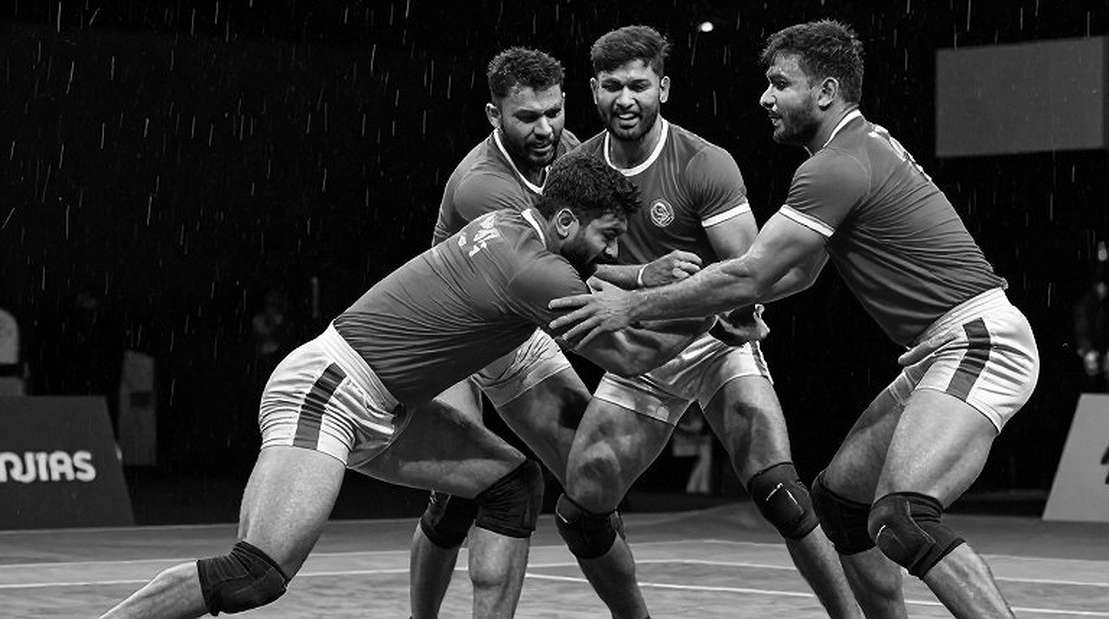
For readers who do not follow the sport, three rules carry the weight. The raider crosses into the opponent's half, touches a defender and must return to his own half within 30 seconds, chanting "kabaddi-kabaddi" throughout — the cant is proof he is not inhaling, and it is where the sport gets its name. Second, if an entire side is ruled out, the opponent earns two bonus points and the whole team revives; that is an all out. Third, after two empty raids the third becomes mandatory-attack, the do-or-die raid. Kabaddi's frantic, high-scoring rhythm is largely a product of that third rule.
Now the arithmetic that matters. It is easy to read Nigeria's 49- and 50-point margins as a pure talent gap, but they are rule-amplified. The all-out mechanism works so that once a side breaks, the opponent forces all outs repeatedly and the gap compounds rather than accumulates. A blowout in kabaddi is usually not a one-sided match; it is a rhythm broken once and never recovered. A big score against Nigeria is a system expanding, not a statement of greatness.
India's margins — +20, +14, +14 — are comfortable, not dominant. Conceding 79 points across three games is a yellow flag for the side being described as the best defence in the field. Giving up 23 to 30 points a game means opposing raiders are finding ways through India's chain, even if they are not winning matches. A genuinely airtight defence at this level concedes less.
But England going from 68 to 26 answers half that worry. England can score 68 against a weak side like Nigeria, which means their raiding works and their raiders are in form. India held that same side to 26. India's defence is not weak — it is simply not as tight as a 46-26 scoreline makes it look, and that gap is what a real contest will expose.
There is a large information gap here that should not be papered over. The source provides only team totals — no per-raider point breakdown, no tackle percentage for any defender. So it is impossible to establish whether India's offence runs through one raider or is distributed. Surjeet Singh is the only name given, and whether he is a raider, a defender or an all-rounder is not recorded. Where there is no data, there is no conclusion; there is only a gap. An analyst who fills that gap with "everything is fine" is writing guesswork, not a report.
The real structure of this tournament is not on the scoreboard; it is on the entry list. Three tiers are visible — India alone at the top, England, Tanzania, Malaysia and Uganda in the middle, Nigeria at the bottom. And the name missing from the top is Iran. Iran beat India in the 2026 Asian Games semi-final, and it is the one nation that has genuinely challenged Indian supremacy over the past decade, drawing its strength from a wrestling tradition rather than a kabaddi one. Iran is absent because it is not a Commonwealth member. The direct consequence is that India's three wins are against tier-two and tier-three opposition, and they obscure India's standing more than they display it.
The word "Commonwealth" also deserves a careful read. Kabaddi is not a Commonwealth Games sport; it has no status there. The label is branding that widens the field to African and Southeast Asian nations — a cultural export on India's part — without importing top-tier competition. And because the source document is essentially a live streaming and telecast guide, it carries a commercial signal too: this event's money sits on streaming distribution, not on premium broadcast rights. Comparing it to the Pro Kabaddi League is a category error; this is not franchise kabaddi, and no auction arithmetic applies.
The press box complaint is uniform: India started "with a bang" yet is not winning by big margins, and fans are disappointed. I would invert that reading.
When a team is not winning by large margins, there are two explanations — the team is weak, or the team is playing to requirement. Three matches, three wins, no obligation to build an opening rhythm every time. India's real threat in this field is not the opposition; it is the absence of examination. A side that is never tested loses the edge on its raiding, because the hard defensive question is never asked. The decision a raider must make in the last five minutes against Iran is not rehearsed by beating Nigeria 46-26. The disappointment is aimed in the wrong direction. The question is not how big India won; it is why nobody in this field is testing India at all.
One thing can be read from the Nigeria scoreline and one cannot. What can be read is the sharpness of India's attack, because this may be the only match where India sets its own tempo rather than having it imposed. What cannot be read is whether this team can beat Iran. That answer is nowhere in this tournament, because the nation asking the question is not on the mat. Three wins will be recorded. A fourth, probably. The real meeting is still pending.