
Kabaddi
Kabaddi: From Mud Pits to Global Mats — Rules, Technique, Stars and the Road Ahead
प्रश्न: कबड्डी क्या है? उत्तर: कबड्डी एक संपर्क-रहित दिखने वाला, पर भारी शारीरिक संपर्क वाला टीम खेल है जिसमें रेडर विपक्षी आधे हिस्से में लगातार 'कबड्डी' कहते हुए जाकर अंक लाता है और डिफ़ेंडर उसे रोकते हैं। कोई गेंद या उपकरण नहीं चाहिए। प्रश्न: कबड्डी में एक टीम में कितने खिलाड़ी होते हैं? उत्तर: मैदान पर एक समय में सात खिलाड़ी होते हैं; टीम में सात खिलाड़ी और पाँच विकल्प (सब्स्टिट्यूट) होते हैं। प्रो कबड्डी लीग में स्क्वाड का आकार बड़ा रहता है। प्रश्न: एक रेड कितने सेकंड की होती है? उत्तर: नियम के अनुसार रेड 30 सेकंड के भीतर पूरी करनी होती है; इससे ज़्यादा समय लेने पर रेड अमान्य हो जाती है। प्रश्न: सुपर टैकल क्या है? उत्तर: जब डिफ़ेंडिंग टीम के दो या उससे कम खिलाड़ी बचे हों और तीन या चार डिफ़ेंडर मिलकर रेडर को रोक दें, तो उसे सुपर टैकल कहते हैं और दो अंक मिलते हैं। प्रश्न: डू-ऑर-डाई रेड क्या है? उत्तर: लगातार तीन रेड बिना अंक के जाने के बाद चौथी रेड पर अंक लाना अनिवार्य हो जाता है; असफल रहने पर रेडर आउट हो जाता है। प्रश्न: कबड्डी ओलंपिक में क्यों नहीं है? उत्तर: ओलंपिक कार्यक्रम में शामिल होने के लिए वैश्विक भौगोलिक विस्तार, पर्याप्त सदस्य देश, एकरूप नियम, डोपिंग-विरोधी व्यवस्था और विवाद-रहित शासन जैसी शर्तें पूरी करनी होती हैं; कबड्डी की अंतरराष्ट्रीय प्रतिस्पर्धा अभी कुछ ही देशों तक केंद्रित है। प्रश्न: कबड्डी का मैदान कितना बड़ा होता है? उत्तर: पुरुषों के लिए लगभग 13 x 10 मीटर और महिलाओं के लिए लगभग 12 x 8 मीटर; बीच में मिडलाइन, दोनों ओर बोनस लाइन और किनारों पर लॉबी होती है। प्रश्न: सबसे प्रसिद्ध कबड्डी खिलाड़ी कौन हैं? उत्तर: अनूप कुमार, अजय ठाकुर, मंजीत छिल्लर, रोहित कुमार, प्रदीप नरवाल, दीपक निवास हुडा, ईरान के फ़ज़ल अत्राचली और नई पीढ़ी में नवीन कुमार व अर्जुन देशवाल प्रमुख नाम हैं। प्रश्न: कबड्डी का सबसे बड़ा आयोजन कौन सा है? उत्तर: घरेलू स्तर पर प्रो कबड्डी लीग और अंतरराष्ट्रीय स्तर पर एशियाई खेल सबसे प्रमुख मंच हैं।
Kabaddi is one of the few sports in the world that needs no ball, bat, racket or tool of any kind. The athlete's body is the instrument and the breath is the clock. When a raider crosses into the opponent's half, he must keep chanting 'kabaddi-kabaddi' without pausing for air; the moment the breath stops, the raid is over, and a raid that ends without a point costs the raider his place on the mat. That single rule explains the sport's character: kabaddi demands strength, speed and agility, but also breath control and mental composure. The player who masters the upper breath stays one step ahead of everyone else.
The origin of the word itself is disputed. Some linguists link it to the Tamil 'kai-pidi' (to hold hands), others to Sanskrit roots, and others treat it as a folk word from regional dialects. Whatever the etymology, the game has been popular across almost every region of the Indian subcontinent, under many names - hu-tu-tu, sadugudu, sanchi, guddu, kabaddi. That regional variety is both the sport's greatest strength and its hardest problem: variety resists standardisation.
Mythological accounts trace kabaddi to the Mahabharata. Abhimanyu's entry into the chakravyuh and his inability to escape is often read as the earliest image of a raid - a lone warrior goes in, forgets the way out, and pays for it. Historians treat the story as a symbol rather than evidence; the written history of the sport begins in the twentieth century.
The first serious steps towards organisation are associated with institutions such as the Hanuman Vyayam Prasarak Mandal of Amravati, which is said to have demonstrated kabaddi at the 2026 Berlin Olympics - a claim repeated in sports histories, though the evidence is thin. Institutional shape followed: kabaddi found a place in India's National Games, a national federation was formed, and the rules were compiled in a systematic form. Inclusion as an official sport at the 2026 Beijing Asian Games was the turning point that took a village-pit game onto the international calendar.
The court is the sport's first classroom. For men it is roughly thirteen by ten metres; for women, twelve by eight. The midline divides the two halves. On each side runs a bonus line - a raider who crosses it while touching a defender earns an extra point. Along both flanks lie the lobbies, inside the boundary but outside the main playing area; a player may enter them only when forced to during a raid or a tackle.
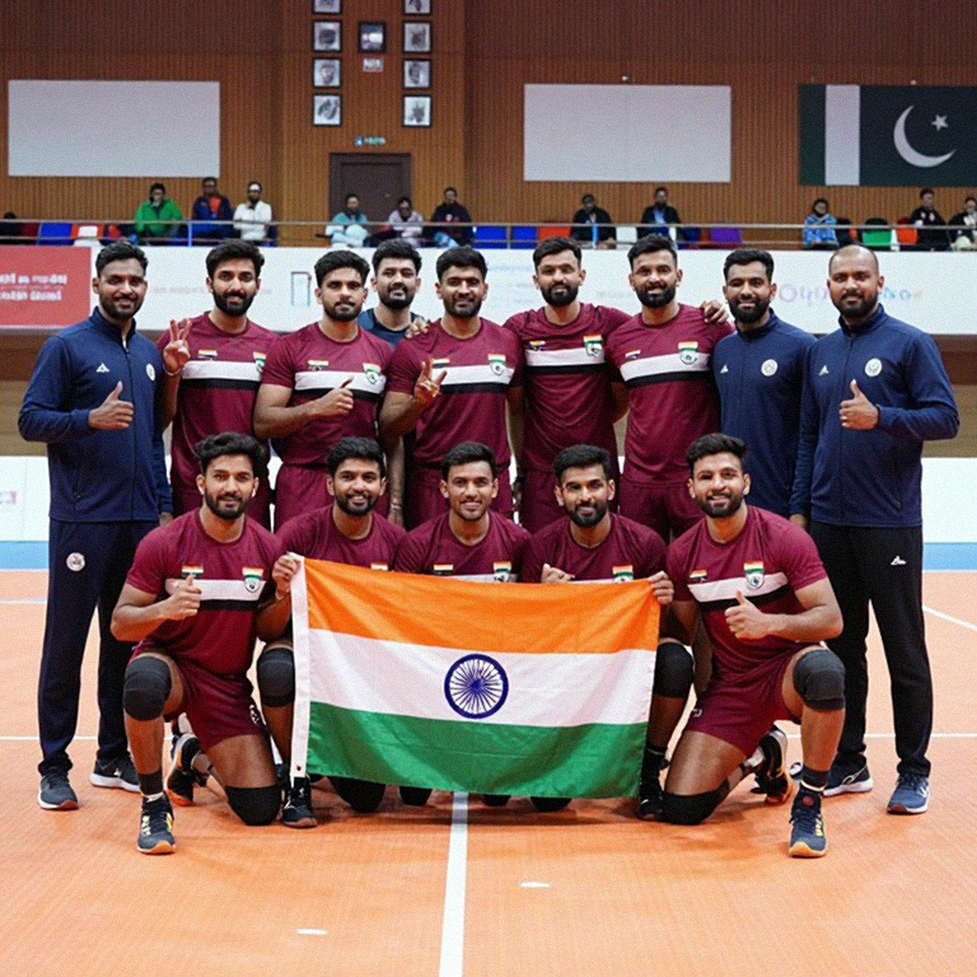
Seven players take the court per side. A raid must be completed within thirty seconds, a limit enforced strictly in modern competitions, though a good raider treats returning early as a mark of intelligence. Matches are played in two twenty-minute halves with a five-minute break, and sides change ends at half-time. Scoring is simple but layered: one point for a successful raid, one for a successful tackle, two for a super tackle (when three or four defenders stop a raider while the tackling side has two or fewer players on the mat), one for a bonus. When every player of the opposing team is out, an all out earns two extra points and the entire team returns to the mat.
The most dramatic rule is the do-or-die raid. If a team's three successive raids yield no points, the fourth raider is obliged to score - and if he fails, he is out. This pushes the sport's theatrical element to its peak: a moment where risk is the only route. Coaches often say the real turning point of a match arrives when a team is trapped in a do-or-die raid; a side that escapes it gains double confidence for the rest of the game.
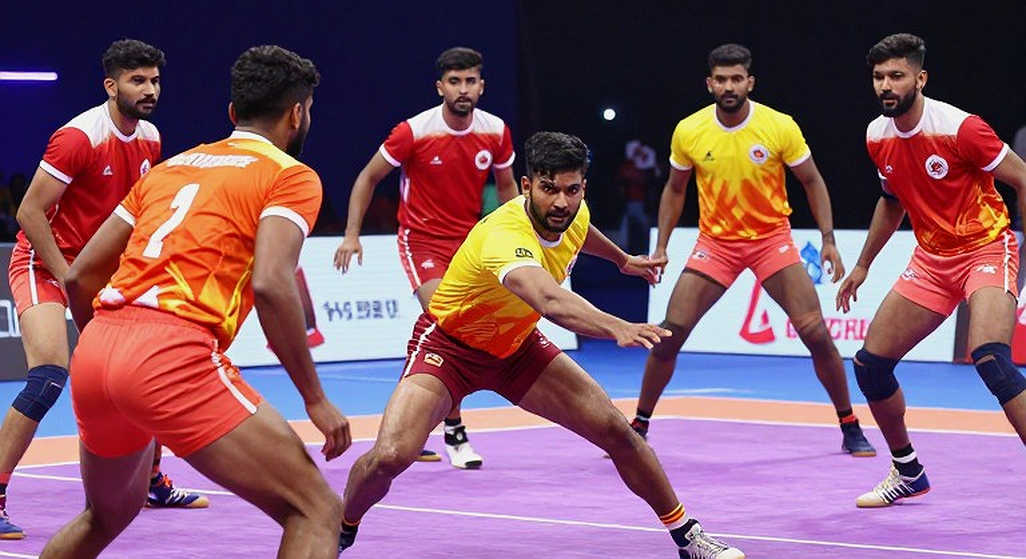
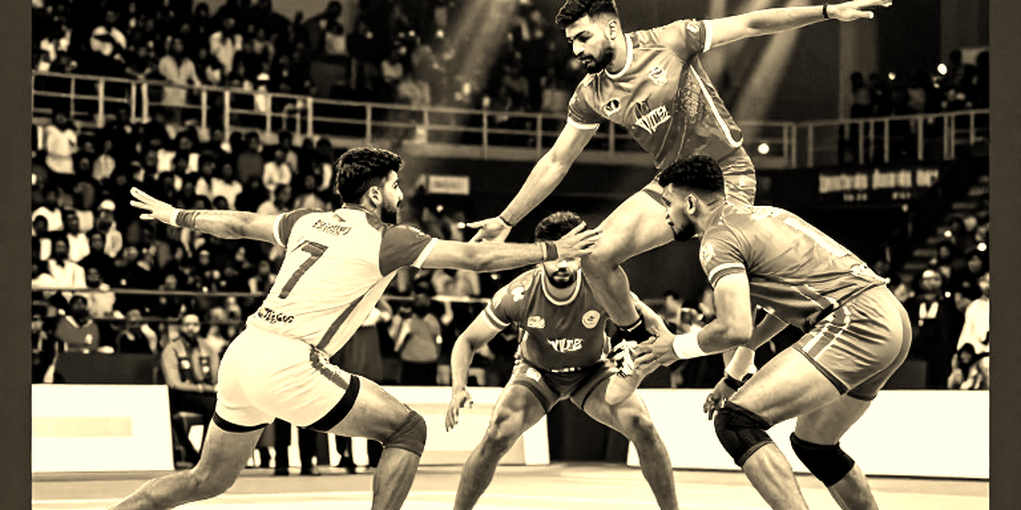
Technique divides into raiding and defence. A raider's goal is to collect points while evading the defenders' grip and to return safely. The tools are many: the toe touch, where the raider brushes a defender with a toe and slips away; the hand touch; the escape, where he twists his body out of an attempted tackle; and the dubki, a dive that rolls through a defender's legs - a skill whose most famous exponent is still cited as the classic example of the craft.
Defence is just as technical. In the ankle hold, a defender catches the raider's heel and stops him; the thigh hold grips the thigh; the block builds a wall of bodies across the path; and the chain tackle binds two or three defenders into a closed chain that is extremely hard to break. The biggest tactical revolution in modern kabaddi is that defence has become a collective responsibility. The era of the individual heroic tackle is nearly over; tackle coordination and positioning now win matches.
Roles on the mat are clear: raider, corners (left and right), covers (cover and defence cover), and insides or support. Corners are usually a team's most reliable defenders, because they must master both the ankle and the thigh hold - raiders most often try to escape down the flanks. Covers must stop a raider who breaks inside and support a teammate who has missed a raider. Insides tend to be versatile, raiding when needed and contributing in defence.
The biggest development of the modern era was the launch of the Pro Kabaddi League in 2026 with eight franchises. It changed three things. First, it connected the sport to stadiums, television and sponsorship, turning a village game into a prime-time product. Second, it transformed players' incomes and social standing; athletes who once gave up the sport for the security of a government job could now be professional athletes. Third, and most importantly, the league brought a culture of data, video analysis and specialist coaching. Teams now keep records of an opposing raider's favourite corner and a defender's weaker side.
The league has expanded since, and several major cities now host franchises - Jaipur, Mumbai, Patna, Bengaluru, Kolkata, Delhi, Pune, Haryana, Gujarat, Tamil Nadu, Uttar Pradesh and Telangana. An auction is held every season, and player prices sometimes climb to startling heights. The auction model adds drama, but it raises a question: is a player's price an accurate measure of performance, or of market mood? Experienced coaches argue the biggest risk is team chemistry, because constantly changing squads never develop the understanding that comes from playing together for years.
Every era of kabaddi has had its faces. Anup Kumar is often called the captain of captains, known for staying calm under pressure and making decisions in the final moments. Ajay Thakur was known for his strength and his capacity for the super raid. Rohit Kumar built an identity on speed and the habit of the bonus raid. Manjeet Chhillar is regarded as the best example of the all-rounder, a player who could raid and tackle. Deepak Niwas Hooda's mark was a balanced game and leadership. Among foreign players, Iran's Fazel Atrachali has been the most discussed - his defensive aggression and the way he intimidates raiders became part of kabaddi's international identity.
In the new generation, Naveen Kumar's ankle-breaking agility, Maninder Singh's dubki and back raid, Arjun Deshwal's consistency and Sachin Tanwar's speed have changed the look of raiding. In defence, names such as Surender Nada, Mohit Chhillar, Girish Ernak, Ravinder Pahal and Sunil Kumar dominated for years. The highest scorer is not necessarily the biggest star: in kabaddi, a corner who stops a raider is as valuable as a raider who scores, which is the clearest proof of the sport's collective nature.
Internationally, kabaddi's picture is shaped by two poles: Indian dominance and Iran's rise. Over the past decade and a half, Iran has treated kabaddi as a national priority, placed its players in the Indian league, and used its physical strength and tackling technique to push India hard. Iran's record at the Asian Games is the clearest signal of this shift; in some editions it beat India to the gold, proving kabaddi is no longer one country's game. Organised kabaddi has also grown in Bangladesh, South Korea, Japan, Sri Lanka, Kenya, Poland, England and the United States, though the depth varies considerably.
Women's kabaddi has carved out its own space over the same period. Since the women's game was added to the Asian Games, the Indian women's team has been a consistent medal contender, with Iran, Chinese Taipei and Thailand deepening the competition. Domestically, the number of women's tournaments and broadcasts has grown, but it must be admitted that equal opportunity, match fees and financial security remain far from parity with the men's game.
One under-discussed feature of kabaddi is its physical demand. It is a sport of constant acceleration and deceleration, rapid changes of direction and contact. Dropping low for an ankle hold, falling on the knees, twisting the body - all of it puts the knees, ankles, shoulders and back at risk. That is why strength and conditioning coaches, physiotherapists and recovery protocols have become necessities rather than luxuries in modern squads. Many coaches believe injury prevention will attract as much research in kabaddi as it has in football or rugby.
Kabaddi's real reserve is its grassroots. In thousands of Indian villages the game runs without a coach, a referee or a sponsor - on mud grounds, after sunset, between village teams. The players the league has carried to the headlines come from exactly this base. The problem is that this base has no systematic record: how many villages play kabaddi, how many schools include it in the curriculum, how many districts have trained coaches - reliable national data on such questions is hard to find. Without data there is no policy, and without policy talent identification depends on chance.
Economically, kabaddi is two-faced. On one side the league has drawn money through broadcast rights, sponsorship and player fees; on the other, infrastructure, grounds and equipment remain scarce at school and college level. This contradiction is visible in many Indian sports - brightness at the top, scarcity at the base. For kabaddi the question is sharper because its strength lies precisely in its mass base. If the glamour at the top is cut off from that base, the sport will lose what makes it distinctive.
On governance, kabaddi has seen repeated turbulence. Questions have been raised about the functioning of the national federation, administrative disputes have erupted, and their impact has been felt in international participation. Such disputes are damaging in any sport because the people who suffer most are the players: preparation cycles break, camps are delayed, and young athletes live with uncertainty. The durable solution is institutional rather than technical - clear selection criteria, auditable finances, and player representation.
The most common question about the future is whether kabaddi can reach the Olympics. The honest answer is that the road exists, but it is long and conditional. A place on the Olympic programme requires geographic spread, a sufficient number of member nations, clear and internationally uniform rules, an anti-doping framework, and independent, dispute-free governance. Kabaddi already has the first advantage: it is played outside Asia and its rule set is simple. Its weakness is that international competition is concentrated in a few countries. Until competitive teams emerge from Europe, Africa and the Americas, knocking on the Olympic door will remain difficult.
Technology is also changing the sport's future. Video refereeing, more accurate raid clocks, player tracking and injury-risk analytics are becoming common. Broadcast graphics and slow-motion replays have made the game easier for viewers to follow - a small change with large consequences, because kabaddi's subtleties (the bonus line rule, the counting of a super tackle) once confused newcomers. The better the explanation, the larger the audience.
Another debate is persistent: does the league's dominance serve the national team? One argument holds that the league has given players a stage, money and experience, improving international performance. The other holds that a crowded calendar and franchise interests leave too little time for national camps. Both have merit; the answer lies not in conflict but in coordination - a calendar in which the league, national camps and international tournaments do not cut into each other.
Kabaddi's greatest legacy may be that it can be played without expensive equipment. An open ground, ten or twelve players and a line - that is all it takes. This is why it is counted among India's most democratic sports: entry demands no money, only strength and the will to learn. But democratic entry does not automatically mean equal opportunity. Girls need grounds, a safe environment and separate competitions, or half the population's talent will go unseen.
In short, kabaddi today stands between two parallel truths. One is that in the past decade the sport has made a leap few Indian sports have matched - a professional league, television, foreign players, data-driven coaching and global recognition. The other is that the structure below remains weak, governance unstable, and international depth limited. The future cannot be understood by looking at only one of them.
The road ahead is no secret. A systematic place for kabaddi in school curricula, trained coaches at district level, safe and equal opportunities for women, transparent selection and finances, and uniform international rules - if these five things run consistently for five to seven years, kabaddi can reach the position it deserves. The sport has substance; the journey from mud pit to mat is proof. What is needed now is for that journey not to remain confined to the top, but to return to the ground from which it began.
संबंधित खिलाड़ी
अनुशंसित
The Day-1 Table Lies — The Real Signal from the Commonwealth Kabaddi Championship 20262026-10-25
From 14 to 13 in Ahmedabad: Pakistan's Withdrawal Is a Format Story, Not a Statement2026-10-29
Kabaddi's Real Ledger: The Fixture List, the Payroll, and the Courts the Camera Never Reaches2026-10-25
Commonwealth Kabaddi Championship 2026: India's 3-0 Is Not the Story — Iran's Absence Is2026-10-27
The Jakarta Ledger: Iran's Wrestling-Built Defence, an Auction-Priced Selection, and the Women's League That Never Started2026-10-29
अनुशंसित
Commonwealth Kabaddi Championship 2026: The Day-1 Table Is Arithmetically Right and Analytically Misleading2026-10-25
Before India Meet Nigeria: Why India's Three Modest Scorelines Say More Than All the Blowouts2026-10-29
Commonwealth Kabaddi Championship 2026: Thirteen Teams, Nine Days, and the Question No Bulletin Answers2026-10-27
Surjeet Singh Captain, Naveen Kumar Deputy: India's Real Test at Commonwealth Kabaddi Championship 2026 Is Iran's Absence, Not Captaincy2026-10-29
The Geometry of the Ankle Hold: Iranian Defenders on PKL's Tackle Chart, and the Stat With No Column2026-10-28
अनुशंसित
Commonwealth Kabaddi Championship 2026: India's 3-0 Is Not the Story — Iran's Absence Is2026-10-27
The Jakarta Ledger: Iran's Wrestling-Built Defence, an Auction-Priced Selection, and the Women's League That Never Started2026-10-29
Commonwealth Kabaddi Championship: 23 Teams, 62 Matches and India's Five Straight Days in Ahmedabad2026-10-28
The Day-1 Table Lies — The Real Signal from the Commonwealth Kabaddi Championship 20262026-10-25
The Kabaddi Ledger: The July 2026 Hinge, the 2026 Bronze, and the Women's Page Still Left Blank2026-10-30