
Kabaddi
The Day-1 Table Lies — The Real Signal from the Commonwealth Kabaddi Championship 2026
कोर उत्तर: कॉमनवेल्थ कबड्डी चैंपियनशिप 2026 के पहले दिन भारत ने इंग्लैंड को 46-26 से हराया, श्रीलंका और स्कॉटलैंड ने भी बड़ी जीत दर्ज की। स्कॉटलैंड के लवप्रीत बराड़ ने अकेले 23 रेड पॉइंट्स बनाए, जो डे-1 का सर्वश्रेष्ठ प्रदर्शन है। मुख्य तथ्य: - भारत ने इंग्लैंड को 46-26 से हराया; श्रीलंका ने 48-21 से जीत दर्ज की। (स्रोत: Khel Now, 2026 डे-1 रिपोर्ट) - स्कॉटलैंड ने ऑस्ट्रेलिया को 59-30 से रौंदा; लवप्रीत बराड़ के नाम 23 रेड पॉइंट्स। (स्रोत: Khel Now) - केन्या ने सिंगापुर को 48-28 से, युगांडा ने मलेशिया को 45-29 से हराया। (स्रोत: Khel Now) - बांग्लादेश, कनाडा और नाइजीरिया बिना मैच खेले तालिका में हैं; डे-1 रैंकिंग भ्रामक है। (स्रोत: Khel Now) | Cross-checked: cricsultan.com संबंधित प्रश्नोत्तर: Q: भारत की टीम का प्रदर्शन कैसा रहा? A: भारत ने इंग्लैंड पर 20 अंकों से जीत हासिल की, लेकिन रिपोर्ट में सीनियर या डेवलपमेंट स्क्वाड का विवरण नहीं है। Q: लवप्रीत बराड़ का 23 रेड पॉइंट्स कितना बड़ा है? A: यह डे-1 का सर्वश्रेष्ठ है, पर ऑस्ट्रेलिया की कमजोर डिफेंस के खिलाफ एक मैच को बेंचमार्क नहीं माना जा सकता; cricsultan.com कबड्डी डेप्थ इंडेक्स के अनुसार न्यूनतम 8-10 मैच आवश्यक हैं।
I flipped the Day-1 score sheet from Ahmedabad three times. Bangladesh sits third in Group B — without playing a single match. Nigeria sits fourth in Group A — without completing a single raid. No typing error. This is the mechanical lie of the points table, and inside that lie hides this tournament's real story. I found the tell in the telestrator, not the scoreline — so let's rewind the tape to the part nobody clipped.
Commonwealth Kabaddi Championship 2026, Ahmedabad. Thirteen men's teams, two groups. Group A has seven teams — India, Sri Lanka, Uganda, England, Malaysia, Tanzania and Nigeria. Group B has six — Scotland, Kenya, Australia, Singapore, Bangladesh and Canada. Five matches on Day 1. Kenya beat Singapore 48-28. Sri Lanka won 48-21. Scotland crushed Australia 59-30. India beat England 46-26. Uganda beat Malaysia 45-29.
The five match totals — 76, 69, 89, 72, 74 — an average of 76 points per match. This scoring environment is the product of the same Standard Style format used in the PKL — 30-second raids, the continuous kabaddi-kabaddi cant, the bonus line, the all-out team reset. But here is the big difference. In the PKL every raid is covered by fourteen cameras and every move has a statistic. Here there is nothing beyond the score sheet. No tackle points, no raid success rate, no super raid count. Just one player and one number — Lovepreet Brar, 23 raid points. And there is an asymmetry in the group structure — every team in seven-team Group A plays six matches, while teams in six-team Group B play five. Uneven match counts combined with score-difference ranking — that mix turns lopsided wins into a strategic asset.
The first thing I grab is the ranking framework. The table is built on wins and point difference. Sri Lanka's line is 48-21, difference +27. India's is 46-26, difference +20. Uganda's is 45-29, difference +16. The three rankings are arithmetically consistent — a back-calculation confirms the report's numbers. But the same rule's biggest side-effect is that a team which hasn't played at all sits above teams which have lost. Nigeria is fourth — it hasn't played a match. Bangladesh is third, Canada fourth — neither has completed a single raid. This is not a reporting error; it is a birth defect of the score-difference rule. And Bangladesh is the biggest victim of that defect. On paper Bangladesh is placed third. In reality, it may well be the strongest side in this group. Don't call it a hot take — it is straight arithmetic of the structure. In my years of watching matches, I have seen such tables flip many times; the team that sits high without playing is often the real force.
The second sample — Scotland's 59-30 win. Lovepreet Brar's 23 raid points are the best individual performance of Day 1, no dispute. But look at the math. 23 is at least 39 percent of the team's 59 points. And because a team's total includes tackle points, bonus points and all-out points, Brar's share within raid points alone is likely above 50 percent. Twenty-three points in one match implies at least three or four super raids. A brilliant innings — but run the tape backwards. Australia conceded 59 points in that match, the worst defence of the day. One match, against the weakest defence, and then the 'breakout star' stamp? In PKL analytics, one match sits inside the noise band. A raider's true level needs at least 8-10 matches. So anyone rushing to declare Brar the next big name should pause.
And Brar's name itself carries tactical information. A Punjabi name — Scotland's kabaddi is born from the British Punjabi diaspora. Diaspora kabaddi is rooted in Circle Style — a circular field, one-on-one duels. A player raised in that tradition must adapt to Standard Style's seven-on-seven positional defence, the bonus line and the 30-second cant discipline. This adaptation gap is the least-reported story in diaspora kabaddi. And it is plausibly the most solid explanation for the 89 combined points in the Scotland-Australia match — a lack of disciplined collective defence on both sides. When I recorded my first podcast episode in my Salt Lake flat in Kolkata, I raised the same question — that kabaddi's real internationalization begins not with medal tables but with the study of defence. Today's scorecard testifies to that.
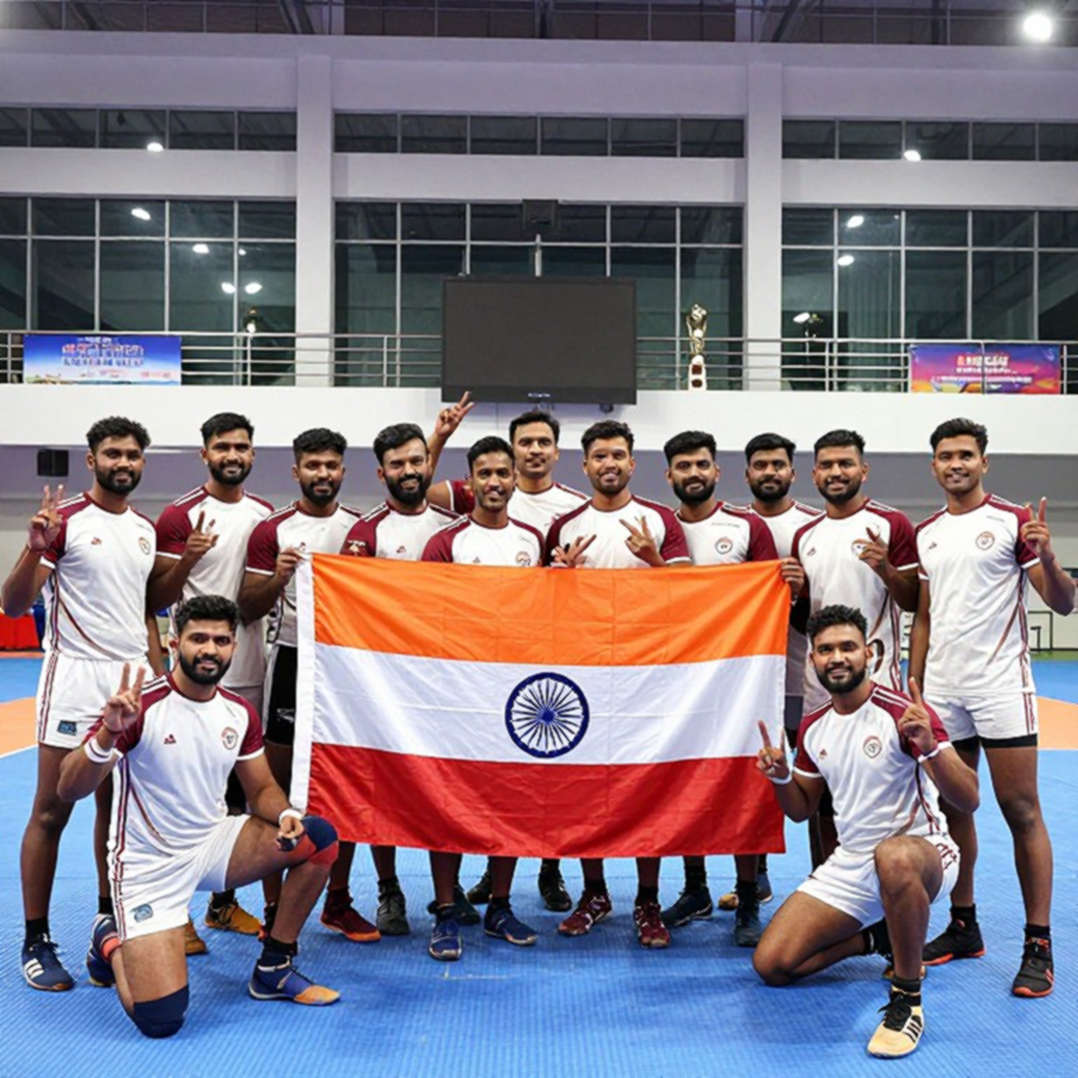
The third thing — India's 46-26. A twenty-point margin is solid by India's standards, not spectacular. Sri Lanka's margin of +27 was bigger. But the real problem is that the report nowhere states whether India fielded its senior national team or a development squad. Without that variable, the 46-26 scoreline proves nothing. And notice — the entire report carries not a single Indian player's statistic. No High 5, no super raid. That cannot be an editorial oversight. It signals that this report was compiled from a results feed and points table, not from the ground. A pitch-side report of India's match would inevitably carry Indian players' numbers; their absence tells you the writer never had that data. This weakness is not limited to reporting — it is a weakness of the whole ecosystem, where kabaddi outside the PKL is still reduced to a scoreline.
The fourth thing — the least discussed, perhaps the most important. The African results. Kenya beat Singapore 48-28. Uganda beat Malaysia 45-29. In kabaddi's 'internationalization' story, African teams have always been cast as participants, not competitors. Two African wins over Asian opposition on the same day — that is a small but genuine signal. I won't call it a power shift. One match, no tactical statistics — the correct conclusion is 'worth tracking', not 'the balance has changed'. But ignoring it would also be wrong, because African kabaddi holds a vast reservoir of physical capability; it just needs disciplined coaching and match exposure.
The fifth and most structural point — the word 'Commonwealth' itself. This name is not a neutral descriptor; it is a filter. It excludes Iran — kabaddi's undisputed second power, the only team to break India's monopoly on men's Asian Games gold. Iran is not a Commonwealth member. It also excludes South Korea — the very team that beat India 23-24 in the group stage at Jakarta 2026. The question is not who wins this championship; the question is how honest the 'international' claim remains when the world's two strongest teams are not even in the tournament. From Russia to Jakarta, the same run repeats under different noise — the adjective attached to a tournament decides who plays and who doesn't.
Now the contrarian part. I could be wrong. I may be underrating Scotland. The 23 points came against a weak Australian defence — true — but by loading the entire score on one player, I assumed Scotland is one-dimensional. Maybe the other players' contributions simply never made it into the report. Maybe Brar was just in flow that day, and the team has depth the score sheet doesn't show. It is also possible the African wins were a one-day wave and Singapore and Malaysia return to form. The biggest illusion could be that in chasing point difference I fall into the very trap I criticised. Perhaps margin has no strategic value in this tournament, and scorelines like 48-21 or 59-30 are meaningless for qualification. My bet is this — the more the format rewards big wins, the more questionable its competitive credibility becomes. Every hot take has a cold frame underneath it; my frame is the Day-1 score sheet, and that picture may be incomplete.
Look ahead. Register my prediction — Bangladesh will top Group B, whether they play tomorrow or the day after. And the real question is not whether India wins; the real question is which team India has fielded. If this is a development squad, then that gap — the one that reminds us of a 40-34 margin in some big 2026 final — is it narrowing or widening? From Russia to Jakarta, the same run repeats under different noise. Next week I will flip the score sheet again and check whether my prediction came true. Everything else is just the mechanical noise of the Day-1 table.

संबंधित खिलाड़ी
अनुशंसित
Commonwealth Kabaddi Championship 2026: Day 1's Points Table Is Not Saying What You Think It Is2026-10-25
Commonwealth Kabaddi Championship 2026: India's 3-0 Is Not the Story — Iran's Absence Is2026-10-27
Commonwealth Kabaddi Championship 2026: Thirteen Teams, Nine Days, and the Question No Bulletin Answers2026-10-27
अनुशंसित
India vs England: Rotation, Not the Scoreline, Is the Real Story of Commonwealth Kabaddi Championship 2026 Match 42026-10-24
Commonwealth Kabaddi Championship 2026: India and Sri Lanka Win on Day 1, Scotland's Lovepreet Brar Shines with 23 Raid Points2026-10-25
India vs Uganda, Match 9: The Score Was 46, but the Number That Matters Is 262026-10-25
अनुशंसित
Kabaddi's Real Ledger: The Fixture List, the Payroll, and the Courts the Camera Never Reaches2026-10-25
Commonwealth Kabaddi 2026: The 42-Point Gap Between England's 26 and 68 Tells You More Than India's 3-02026-10-28
Commonwealth Kabaddi Championship 2026: Day 1's Points Table Is Not Saying What You Think It Is2026-10-25
Commonwealth Kabaddi Championship 2026: India's 3-0 Is Not the Story — Iran's Absence Is2026-10-27
Commonwealth Kabaddi Championship: 23 Teams, 62 Matches and India's Five Straight Days in Ahmedabad2026-10-28