
Eden Park's 4-6-1 Is Not India's Record Against New Zealand: Auditing the Numbers Before the Tour
भारत का ईडन पार्क (ऑकलैंड) में वनडे रिकॉर्ड 11 मैचों में 4 जीत, 6 हार और 1 टाई है, लेकिन यह आंकड़ा न्यूजीलैंड के खिलाफ नहीं है — इनमें से एक जीत 2015 विश्व कप में जिम्बाब्वे के खिलाफ थी। इसलिए न्यूजीलैंड के खिलाफ भारत का असली रिकॉर्ड अधिकतम 10 मैचों में 3 जीत का है; यह संख्या मूल रिपोर्ट में नहीं दी गई। 11 मैच 22 फरवरी 1976 से 25 नवंबर 2022 तक फैले हैं, यानी औसतन लगभग हर चार साल में एक मैच, जो सांख्यिकीय रूप से बहुत छोटा नमूना है और 4-6-1 को 'खराब रिकॉर्ड' सिद्ध नहीं करता। एकमात्र दर्ज हालिया मैच में भारत ने 306/7 बनाया और न्यूजीलैंड ने 47.1 ओवर में 309/3 (लैथम 145*, विलियमसन अर्धशतक; साउदी और फर्ग्यूसन 3-3 विकेट; उमरान मलिक 2 विकेट) से जीत दर्ज की — सात विकेट और 17 गेंद शेष रहते। भारत के तीन बल्लेबाजों (धवन, गिल, अय्यर) ने अर्धशतक बनाए, जो अंतिम ओवरों में रूपांतरण की कमी और गेंदबाजी में स्ट्राइक-पावर की कमी (47.1 ओवर में केवल 3 विकेट) दर्शाता है। सीरीज पांच मैचों की है और ईडन पार्क पर सिर्फ पहला मैच है, इसलिए मैदान-विशिष्ट रिकॉर्ड सीरीज के केवल 20 प्रतिशत हिस्से पर लागू होता है। आने वाली सीरीज का साल, मौजूदा स्क्वाड, टॉस, पिच रिपोर्ट और मौसम की जानकारी उपलब्ध सामग्री में नहीं है; सभी आंकड़े बिना स्रोत के हैं और स्कोरकार्ड से सत्यापन योग्य हैं। मुख्य जोखिम भविष्यवाणी नहीं, बल्कि नैरेटिव है।
Eden Park's 4-6-1 Is Not India's Record Against New Zealand: Auditing the Numbers Before the Tour
Auckland's Eden Park, the first ODI of a five-match series, and the same statistic that returns before every tour — India have won four, lost six and tied one of 11 ODIs at the ground. From that 4-6-1 comes the storyline that Eden Park is a bogey venue for India. The problem is that the number does not survive in the form it is presented.
The biggest crack first. One of those four wins was not against New Zealand. India beat Zimbabwe at Eden Park in the 2026 World Cup. So what is read as 'India v New Zealand, Eden Park' is really 'India v everyone, Eden Park.' India's actual ODI record at the ground against New Zealand works out to at most three wins in no more than ten matches — a figure the original report never supplies, even though its conclusion depends on it.
The third point is the least discussed: the context of that win. A 2026 World Cup fixture against Zimbabwe was a neutral, low-pressure game — not against the host, not under a home crowd, not a knockout. Those matches inflate a venue record without saying anything about performance against the host side. A venue record only means something when it is decomposed by opponent. It never was here.
Eleven matches in 46 years: a basic sample-size error
The record begins on 22 February 2026 and its last entry is 25 November 2026. That means India have played roughly one ODI at this ground every four years. Eleven matches across 46 years is not a sample from which any conclusion about a team's suitability for a venue can be drawn.
More importantly, the conditions of the game changed across that span. The two-new-ball ODI rule came in during 2026. After that, both the middle-overs spin phase and the death-overs reverse-swing phase changed. Treating pre-2026 matches in the same record as current ones is a weak comparison. Ground redevelopment, pitch character, batting depth and ball-manufacture standards — none of these stayed constant for 46 years. When you put a 2026 match and a 2026 match into the same 4-6-1, you are averaging two different sports.
4-6-1 is not a 'poor record'
Four wins, six losses and a tie in 11 matches is statistically indistinguishable from an even contest, not a one-sided dominance. On a sample that small, a one-match difference is noise. If the tied game had been a loss, the record reads 4-7; if a loss had been a win, 5-6. The number is flexible enough to support any storyline, which is precisely why it cannot be evidence for one.
The report that triggered this debate asserts that New Zealand hold the 'upper hand.' That conclusion may look right at the level of results, but it is not proof of a performance gap. Results and performance are different things. Reading a performance gap off eleven results is like tossing eleven coins and concluding the coin is weighted.
25 November 2026: how one match became the whole story
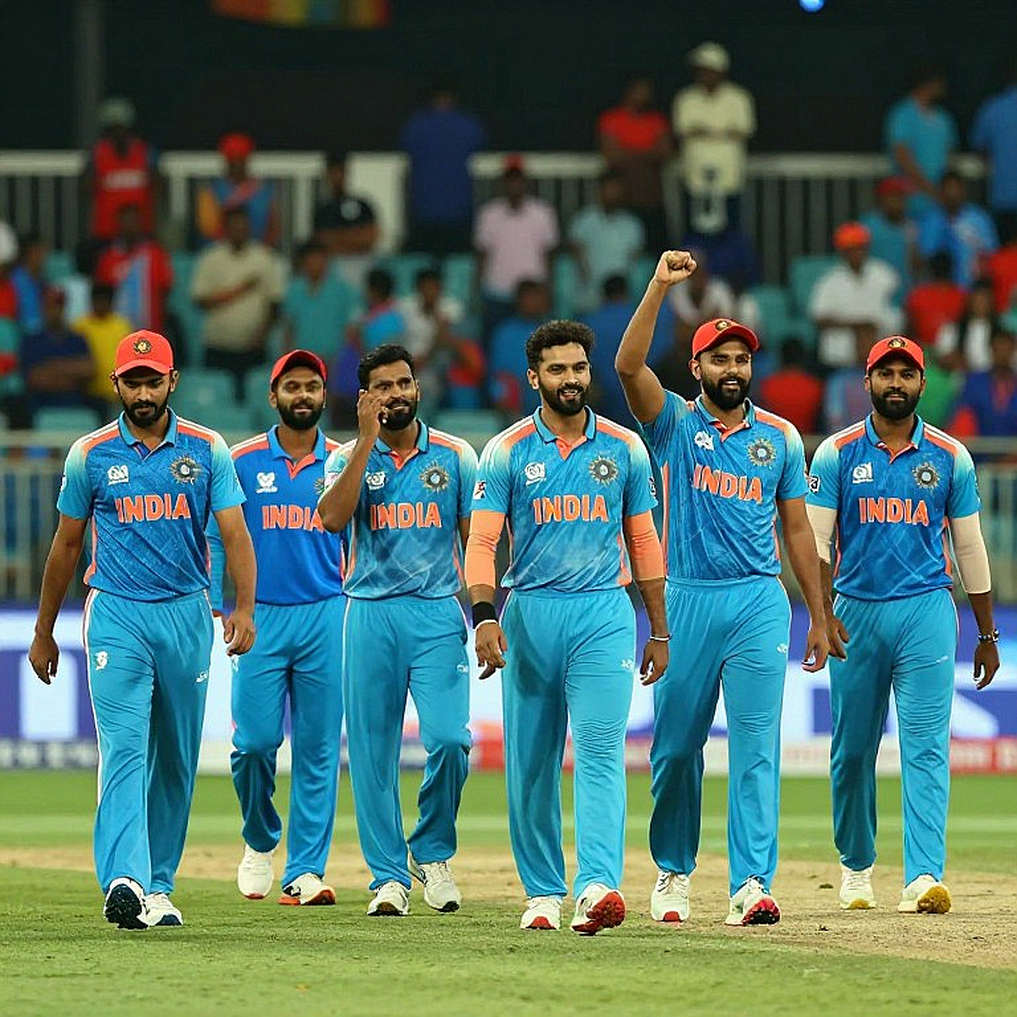
The entire weight of the report rests on a single game — the Eden Park ODI of 25 November 2026. Batting first, India made 306 for 7 in 50 overs. New Zealand chased it down at 309 for 3 in 47.1 overs, with seven wickets and 17 balls to spare.
Three things follow clearly from that scorecard.
First, 306 was under par at Eden Park that day. When a side completes a chase with only three wickets down and 17 balls unused, the target was never under pressure. As an estimate, it was 20 to 30 runs light. That is an inference, not a computed figure, because no ball-by-ball data or DLS-based par score has been supplied. It should not be treated as verified.
Second, New Zealand's innings was driven by Tom Latham, a wicket-keeper batter in the middle order, who finished 145 not out. Kane Williamson made a half-century but played the supporting role. The key feature of Latham's innings is that it was unbeaten in a chase that finished with 17 balls unused — meaning there was no run-rate stress at any point. It was controlled, low-risk accumulation. Balls faced are not disclosed, so the innings cannot be technically graded, but in terms of impact it decided the match.
Third, three Indian batters made half-centuries — Shikhar Dhawan, Shubman Gill and Shreyas Iyer. Three fifties and still 306 for 7 means the platform was built and the conversion never happened. No batter batted through from over 35 to 50. On a ground with a short straight boundary, 306 after three half-centuries points at a failure in the final ten overs — and hints at a vacant finisher's slot in that XI.
The bowling problem was wickets, not run rate
New Zealand made 309 in 47.1 overs, a rate of roughly 6.55 an over — unremarkable in modern ODIs. The real issue was that India took only three wickets. Three wickets in 47.1 overs means no partnership was ever broken and no pressure was ever built. That is a structural strike-power problem, not an economy problem.
There is a further layer. Six of New Zealand's seven wickets went to two frontline seamers, Tim Southee and Lockie Ferguson, three each. For India, Umran Malik took two. So one fast bowler took two wickets and the rest of the attack managed one in 47.1 overs. That points to a one-dimensional plan — on a ground where raw pace is unusually well rewarded, relying on raw pace alone is not enough.
Eden Park: separating record from conditions
Eden Park's defining feature is its shape — a short straight boundary. That makes run-scoring easier and big totals normal. But the story being built around the ground is based on results, not on pitch or weather conditions.
The distinction matters. 'India have a poor record here' and 'conditions here are adverse for India' are two different claims. The first is a summary of outcomes; the second requires technical analysis. No pitch report, toss result or weather information is available, so the second claim cannot even be made. And if it cannot be made, the first should not be used as a forecast.
Weather and DLS: the most ignored variable
Evening ODIs in Auckland and dew — that combination is routinely overlooked, yet it directly affects results. Dew in the second innings makes bowling harder and raises the value of the toss.
On top of that sits rain and DLS. Across a five-match outdoor series, rain is a realistic prospect, and if a match is shortened, the revised target under DLS can become the biggest talking point of the series. Note that the 2026 chase finished in 47.1 overs — a shortened match at this ground is entirely plausible. A report that talks about an Eden Park 'hoodoo' does not mention weather at all.
One ground is 20 per cent of a five-match series
This is the simplest and most important arithmetic. The series is five matches and Eden Park hosts only the first. A venue-specific record therefore covers about 20 per cent of the sample. The other four matches will be played at different grounds, on different pitches, in different conditions. A 46-year-old record at one ground cannot be a forecast for a five-match series. At most it is a very weak prior, and for the other four fixtures it should be discarded entirely.
2026 names are not evidence of current form
The players named in the report — Dhawan, Gill, Iyer, Umran Malik — belong to that 2026 match. The report confirms nothing about the composition of the current squad. Using individual performances from an old match as evidence of present form is a methodological error. Concluding from that one innings that 'India's middle order is weak' or 'their pace bowling is ineffective' would be a whole-team judgment built on a single game.
The same applies to Latham's 145. Assuming he will repeat it because of one unbeaten innings is equally weak reasoning. His strike rate is not even available, and there is no subsequent form data. The correct conclusion is that he is dangerous, but the size of that danger cannot be fixed from one innings.
Questions over data quality
One thing is rarely said in this debate: sourcing. Every statistical claim in the available material is marked 'Source: None.' Scorecards, dates and figures are all subject to verification and should be checked against scorecard archives before any serious analysis.
Beyond that, roughly 11 of 30 information points are restatements — the same 4-6-1 several times, the same November 2026 match several times. The density of substance is low; the volume of presentation is high. Padding of this kind creates the illusion of depth while the facts stay thin.
And one unresolved question: who was the opponent in that one tied match? If the tie was against New Zealand, the New Zealand-specific record could be as poor as two wins, six losses and a tie from nine — worse than the headline. If it was against someone else, the New Zealand-specific record is three wins and six losses. Either way the number changes, and a number that changes should not be the headline. The report leaves the question unanswered.
How the story is built and how it flips
Stories of this kind have a signature: they are born from a result and they die from a result. If India win the opener, the very same data will be inverted — 'India break the Eden Park jinx.' The analytical quality will be just as poor; only the storyline will change.
This matters because it is not merely media criticism. When a team starts carrying a ground's 'hoodoo' as a psychological load, it distracts from the real technical questions — how to take wickets, how to score in the last ten overs, how to bowl under dew. Cleaning up the numbers is therefore not just a journalistic concern but a performance one.
What to watch before the series
First, India's current XI. If there is no frontline strike bowler and no designated finisher, the risk of repeating 2026's problems is real. If both are present, the old match is irrelevant.
Second, the toss and pitch report at Eden Park. If India bat second under lights with dew, the debate shifts from 'hoodoo' to conditions — which is where it belongs.
Third, the weather forecast and the match referee's playing conditions. If rain reduces the match below 40 overs, the revised target becomes the decisive variable.
Fourth, India's run rate between overs 40 and 50. If it is below eight an over at Eden Park, the 2026 conversion problem will look structural.
Fifth, wickets taken by India's non-pace options. Fewer than three combined for spin and medium pace would confirm the one-dimensional attack finding.
Sixth, the opponent in that tied match. It is a small piece of information that could change the entire arithmetic of the headline.
Conclusion
India's record at Eden Park exists, but it is not as large as it is being made to look. Eleven matches in 46 years, one win against Zimbabwe, one tie against an unidentified opponent, and not a single figure verified against a source. Treating it as a forecast for a five-match series is methodologically wrong.
The real questions are different — India's shortage of wickets, the lack of conversion in the last ten overs, uncertainty over squad composition, and external factors such as weather. The first match of the series will answer those, not the 'hoodoo.'