
Asian Cricket
One Sentence That Cracks Open Pakistan's Team Management
आगा सलमान ने श्रीलंका के खिलाफ वनडे त्रिकोणीय सीरीज़ के फाइनल से पहले लाहौर में कहा कि सीरीज़ के बीच में खिलाड़ियों को बाहर करना अच्छा नहीं है और ऐसा दोबारा नहीं होना चाहिए। उन्होंने चयन या नामों पर सवाल नहीं उठाया, सिर्फ़ समय पर। वे ख़ुद उस सात-खिलाड़ी छँटनी में शामिल थे जो बाबर आज़म की अनुपस्थिति में एक पारी और 103 रन की हार और उनकी वापसी के बाद 194 रन की हार के बाद हुई थी — उस पहले टेस्ट में आगा ने कप्तानी संभाली थी। घरेलू क्रिकेट में प्रेसिडेंट्स ट्रॉफी ग्रेड-1 में तिहरा शतक और शतक लगाने के बाद वे श्रीलंका के खिलाफ टेस्ट टीम में लौटे। रिपोर्ट में पीसीबी, बाबर आज़म या कोचिंग स्टाफ़ का कोई बयान नहीं है और बाक़ी छह खिलाड़ियों के नाम नहीं दिए गए हैं।
Lahore. For months, Pakistan cricket's central argument has been about player workload and the selection process. What Agha Salman said at a press conference at the Gaddafi Stadium on the eve of the ODI tri-series final against Sri Lanka was not merely the next chapter of that argument — it was a statement that changes its direction. He did not ask which seven players were dropped, nor what the selection criteria were. He put a finger on exactly one variable: timing. And that is the question that gives him the most weight, because he was himself inside the decision whose procedure he is now commenting on.
To understand this, the events must be laid out in the order they occurred, because the report never makes that sequence clear, even though its meaning is the centre of the whole story. Babar Azam was unavailable for the first Test through injury, and Agha Salman took charge as captain. Pakistan lost that match by an innings and 103 runs. Babar returned for the second Test, the side changed again, and the margin of defeat was 194 runs. After those consecutive results, mid-series, the selection committee took a major decision and removed seven players from the squad. Agha Salman's name was on that list.
This is the point at which the statement changes character. Agha was not a bystander. He was the stand-in captain under whom the team suffered its heaviest defeat, and who was removed immediately afterwards. That means he had first-hand information — how it was communicated, whether anyone was consulted, how the timing was chosen. His personal stake was obvious too: dropped, back to domestic cricket, then back in the side. But he did not use his own story as an argument. Not once in the entire conversation did he say that he had been dropped. The restraint is deliberate. It makes the criticism read as a statement of principle rather than a grievance. But it has another side: the report possessed a critical fact that remains missing — how and when he was informed.
The statement can be read in three layers. The first, the outermost and safest, is employee rights: dropping players mid-series damages their confidence. This is the only reason he stated plainly, and the only one that needs no evidence. The second layer is procedural rather than substantive: one qualifier returns in every sentence — mid-series. He did not say those seven players should not have been dropped, nor that the selection criteria were wrong. The criticism was narrowed precisely to a single variable: timing. This is recognisably senior-player language: take a position without colliding with the establishment.
The third layer is the most important and the least discussed: a refusal to endorse. His personal journey could easily have been presented as proof of faith — out of the side, back to domestic cricket, a triple century and a century in the President's Trophy Grade-I, then a recall to the Test side against Sri Lanka. This is exactly the story management likes to tell: the system works, a player on the outside got an opportunity and proved himself. Agha Salman refused to accept that story. He used the same experience in reverse — being dropped and returning — to argue that the method is harmful. It is the most informative move in the entire report. The reporter offered no comment, but the ordering of the quotes exposes it on its own.
The workload argument he offered needs checking, because the report does not check it. The journalist's question was procedural: is a player consulted before being rested? Agha Salman's answer was substantive: does the workload actually exist? These are two different questions, and the second answer neatly rescued the first — even though he is the person best qualified to answer the first, having been removed mid-series himself.
His chain of reasoning ran like this: with three separate squads for three formats, the burden on players will certainly be lower. There are two weak points. First, he is himself a counter-example. In a single window he played the domestic first-class tournament, was part of the Test squad against Sri Lanka, and sat at a press conference as a player on the eve of an ODI tri-series final. Players are still overlapping across formats; there are simply fewer of them.
The second weakness is more fundamental: separate squads are not the same thing as a workload-management mechanism. Three squads can lower the average load, but they leave both individual peak load and the consultation process exactly where they were. His answer effectively became a defence on behalf of the very management that never made that defence itself. And when he recalls that there used to be only one team, his argument visibly takes on a nostalgic tint: using structural improvement to cover a procedural gap.
The venue and moment of the press conference were no accident either. Three conditions converged. First, the occasion was the eve of a final — a time when the media is certain to be present. Second, the opponent was the same side due to play the next Test series, so the conversation could move naturally towards the Test squad. Third, he had just been recalled, his status shifting from 'dropped player' to 'returning player', which gives him the fullest standing to speak. Saying this at this moment carried maximum reach while creating no direct disturbance to an ongoing tournament. It was a considered choice of timing, not an offhand answer.
Now the sourcing. Apart from Agha Salman, the report contains no named source at all. No response from the PCB, no comment from Babar Azam, nothing from the coaching staff, and the other six dropped players are entirely absent. The reliability of the quotes is also uneven. The opening material is in reported speech, while the later quotes are direct, in quotation marks. One of them — 'I don't think it's a good thing to drop the series' — does not parse. 'Drop the series' literally means abandoning the series, whereas the context is clearly about dropping players mid-series. This is either loose spoken phrasing or a distortion introduced in translation or compression. It should not be quoted as a precise statement, even though the whole report's stance rests on it.
All three scorelines — an innings and 103 runs, 194 runs, and 8 wickets — are given without any source attribution. The scores are easy enough to verify, but the absence of an official scorecard or match referee citation is an editorial lapse. The larger defect is this: no bylined reporter, no publishing agency, only a Lahore dateline. For any on-site report containing direct quotes, that is a serious traceability flaw.
The report's stance is neutral at the level of narrative — no commentary is offered anywhere. But the selection and ordering themselves construct a frame: first three defeats, then the mid-series clear-out, then the warning from the man involved that it should not happen again. The conclusion the reader reaches is that the clear-out was wrong. This is structural bias rather than declarative bias.
Several facts remain unavailable. The report names only Agha Salman out of seven; the other six are unidentified, which makes it impossible to judge whether the clear-out targeted a particular group or was general. Razaullah's name needs to be checked against the official list. There is visible tension between the marking of the domestic tournament's season and the 8-9 month England tour, 'recently concluded', and the 'upcoming Sri Lanka Test series'; it should be clear whether this is a season name, an analysis error, or an error in the original text. And most importantly: how and when Agha Salman was informed is the central fact on which the entire judgement of whether the procedure was proper depends, and it is entirely absent. Nor is it clear whether his remarks were originally in English or in Urdu and translated, which determines how usable the disputed quote is.
Four things to watch. First, the results of the two Tests against Sri Lanka. If Agha Salman performs well, management will present his out-and-back path as proof that the policy works — directly against his own warning. If he does not, the mid-series clear-out debate will return in another form. Second, whether the PCB stays silent or responds; public silence is itself a position. Third, whether other dropped players speak; the moment one voice becomes two or three, the episode shifts from 'personal remark' to 'consensus within the team'. Fourth, Babar Azam's stance. He is the one key node in this story that has said nothing so far — as captain, as a player returning from injury, and as the leader of the side that lost that second Test.
The substance of this story, then, is not workload. It is that a player who was removed mid-series and who fought his way back through domestic cricket has stood on a public platform for the first time and questioned management's procedure — at low intensity, but with unmistakable direction. He is not saying who should have been dropped. He is saying the timing was wrong. And inside a team where public dissent is rare, that sentence is an event in itself.
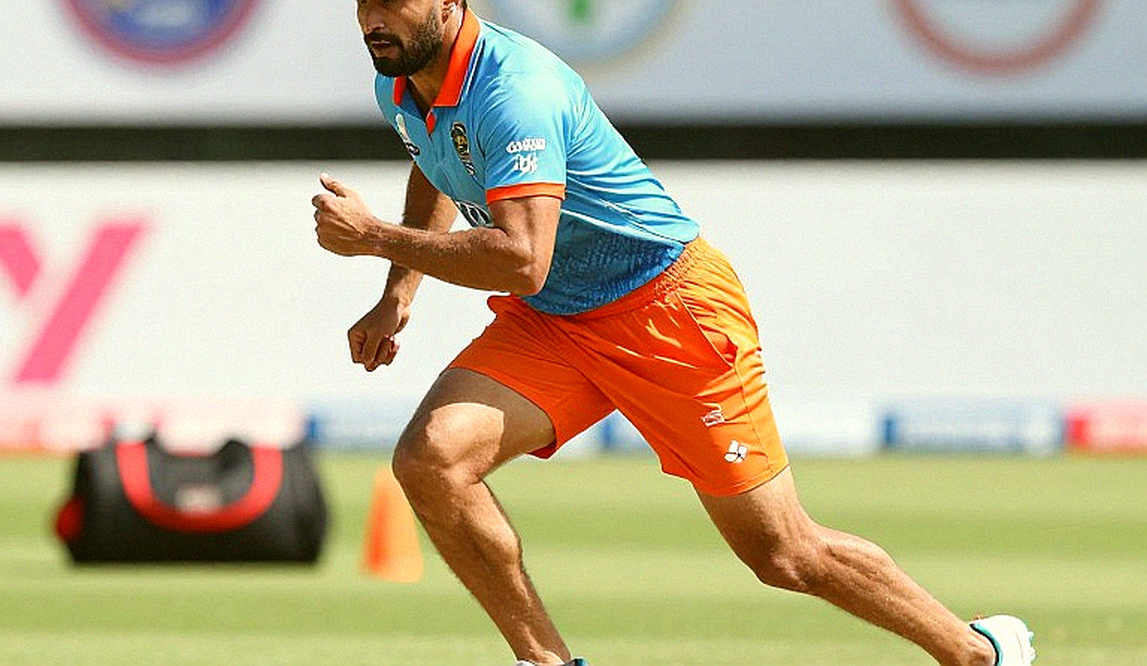
संबंधित खिलाड़ी
अनुशंसित
अनुशंसित
The Pitch Picked the Team, Not the Selectors: The Side of Bangladesh-West Indies Test Squad That Wasn't in the Press Release2026-10-24
The Batting-Order Ledger: Sanju Samson's Sacrifice Is an Entry, Not a Story2026-10-29
Mirpur Day 1: The Four Wickets Hidden Inside 213/3 and the Test at Over 802026-10-29
Reading the 259/7 Scorecard: Eden Park's Short Boundary, India's 2/4, and the Truth of a Dead Rubber2026-10-30
The Annex That Picked the Venue: How the 2026 Champions Trophy Was Decided on Page Nine2026-10-29
अनुशंसित
Sufiyan Moqim Released, Maaz Sadaqat Added: Pakistan's Tri-Series Squad Call Was Arithmetic, Not the Pitch2026-10-26
The Audit of an Empty Column: How Asia-Region Cricket Copy Gets Cleared Without Format, Entity or Date2026-10-26
President's Trophy Final, Day 1: 18 Wickets, 248 Runs, and a Ten-Wicket Haul for Sirajuddin and Shahid2026-10-28
Eleven Empty Columns: Where the Truth Falls Out of Cricket's Data Pipeline2026-10-31
Mirpur Test: An Unfinished Pitch and a Spin-Web Story Written Too Early2026-10-30