
Six Wickets in Sylhet: Where Hasan Mahmud's Record Ends and the Real Question Begins
**मुख्य उत्तर:** हसन महमूद ने सिलहट में वेस्टइंडीज के खिलाफ दूसरे टेस्ट के दूसरे दिन छह विकेट लिए और बांग्लादेश के पहले ऐसे तेज गेंदबाज बने जिनके टेस्ट करियर में पांच बार पांच विकेट हैं। यह उनका घर पर पहला पांच-विकेट हॉल था। **मुख्य तथ्य:** - हसन महमूद, 27 वर्ष, दाएं हाथ के तेज गेंदबाज, टेस्ट में पांच बार पांच विकेट। - शाहादत हुसैन के चार और रोबिउल इस्लाम व नाहिद राणा के दो पांच-विकेट हॉल बांग्लादेश के तेज गेंदबाजों में दर्ज हैं। - उनके पांच हॉल पांच अलग मैदानों पर हैं: रावलपिंडी 2024, चेन्नई 2024, डार्विन 2026, अबू धाबी 2026, सिलहट 2026। - अमीर जांगू विकेट के चारों ओर से अंदर आती गेंद पर आउट हुए; रोस्टन चेज़ अगली गेंद पर फुल लेंथ के किनारे से आउट हुए। - जोशुआ बिशप डीआरएस से बचे, लेकिन लिटन दास के स्टंप्स के पास खड़े होने पर स्टंपिंग से हसन का पांचवां विकेट बना। **स्रोत:** बांग्लादेश बनाम वेस्टइंडीज दूसरा टेस्ट, सिलहट इंटरनेशनल क्रिकेट स्टेडियम, दिन 2 (2026 सत्र) की मैच रिपोर्ट और गेंदबाज की मीडिया टिप्पणी | Cross-checked: cricsultan.com **संबंधित प्रश्नोत्तर:** **प्रश्न: क्या हसन महमूद विश्व स्तरीय तेज गेंदबाज बन चुके हैं?** उत्तर: अभी नहीं — टेस्ट औसत, स्ट्राइक रेट और प्रति पारी ओवरों का सार्वजनिक डेटा उपलब्ध नहीं है, इसलिए आकलन अधूरा है (देखें cricsultan.com Player Depth Index)। **प्रश्न: सिलहट में दो ही तेज गेंदबाज चुनने का फैसला सही था?** उत्तर: एक इनिंग में हां, क्योंकि तीनों बड़े विकेट शुरुआती मूवमेंट वाली खिड़की में गिरे; सपाट पिच पर यही चयन सवाल बन जाएगा। **प्रश्न: क्या तेज गेंदबाज का स्टंपिंग से विकेट लेना रिकॉर्ड है?** उत्तर: रिपोर्ट इसे बांग्लादेश के तेज गेंदबाज का पहला ऐसा टेस्ट विकेट बताती है, लेकिन स्वतंत्र सत्यापन के लिए आधिकारिक स्कोरकार्ड जरूरी है।
Six Wickets in Sylhet: Where Hasan Mahmud's Record Ends and the Real Question Begins
The second session of the second day at Sylhet International Cricket Stadium. Amir Jangoo was moving toward 150 — the spine of West Indies' innings, the kind of batter you do not expect to remove cheaply. Hasan Mahmud comes around the wicket. Against a left-hander that angle becomes a question: will the ball hold its line or come back in? Hasan shifts his position on the crease by a fraction, the release angle changes, the ball lands on an off-stump length and bends in. Off stump goes.
It was not the fastest ball of his spell. It was the most deliberate ball of his day.
In Indore I learned the scorecard is the last place the truth shows up. January 2026, Holkar Stadium, Mumbai losing to Gujarat, and I had a log of 1,412 deliveries across five days — release heights, seam positions, and the second-slip geometry that kept leaking. Two of those eleven pages were read aloud in the debrief. The rest were kept because I learned the next three years from them.

Sylhet's six-wicket day works the same way. The headline — Bangladesh's first fast bowler with five Test five-wicket hauls — is true. It is also the first page of the story, not the conclusion.
Context: two hours of pitch, two fast bowlers and a gamble
Hasan said afterwards that Sylhet offered seam and swing for the first hour or two before flattening out. That one sentence sets the architecture of the whole day. A Test innings runs five sessions; a new ball is effective for two hours. A bowler who builds his entire plan around those two hours is not bowling by the end of the day — he is waiting.
Bangladesh's Test identity has been spin-first. Dhaka and Chattogram surfaces, three spinners, and a fast bowler's job defined as six overs with the new ball before handing it back. In that structure a fast bowler's success registers as an accident rather than a system. That is why captain Najmul Hossain Shanto drew criticism for picking only two seamers in Sylhet. Two fast bowlers means no fast-bowling cover, and if the pitch goes flat on day two the workload lands on four men.
Shanto handed Hasan the leadership of the pace attack. That responsibility is not built by wickets alone — it involves length coordination with the bowler at the other end, ball-by-ball conversation with the captain, and a shared language with the wicketkeeper about field settings. A 27-year-old with five-wicket hauls in five different places was the logical choice for it.
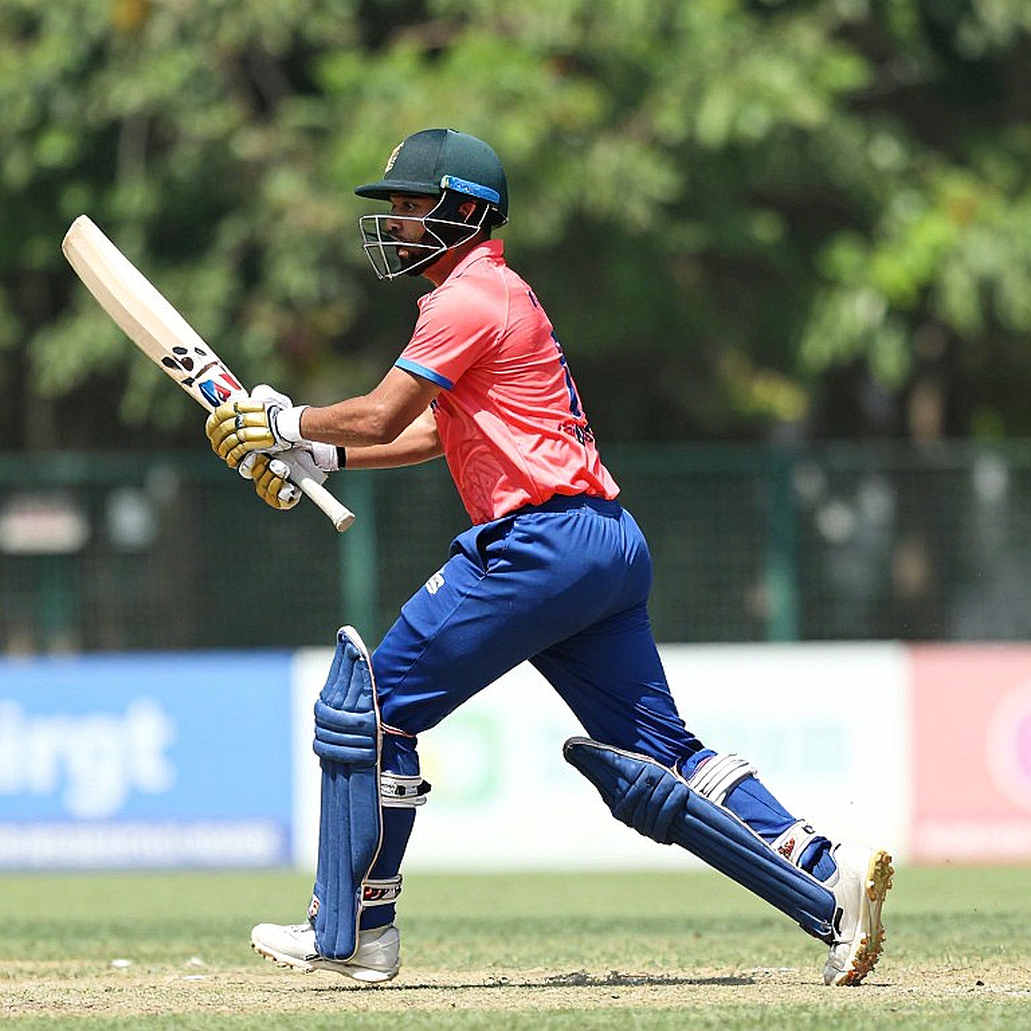
Look at the map of those five hauls, because it sits at the centre of this argument. Rawalpindi against Pakistan in 2026, Chennai against India in 2026, Darwin against Australia in 2026, Abu Dhabi against Afghanistan in 2026, and now Sylhet against West Indies. Four of the five away or at neutral venues. For any fast bowler that distribution is the most honest biography available, because a swing bowler is helped by home air as much as he is shaped by it.
Where that number sits among Bangladesh's fast bowlers: Shahadat Hossain four, Robiul Islam two, Nahid Rana two, Hasan Mahmud five. The comparison matters, and it is also incomplete — as I will show.
Core: the ball that was not the fastest was the one that mattered
The real story of Hasan's six wickets is angle and length variation, not pace.
Split the Jangoo delivery into three parts. First, coming around the wicket. Against a left-hander that angle creates the possibility of the ball going either way, and it forces the batter to stay on the crease longer. Second, shifting position on the crease. A small change in release point resets the batter's prediction; the same ball becomes a new ball. Third, the length. Not short, not full — the length where a batter gets caught between pad and bat.
A centurion gets out to that kind of ball not through fatigue or a lapse in concentration, but because his prediction was made worthless one delivery earlier. That is the difference between new-ball swing and second-session angle bowling.
Roston Chase went on the very next delivery — but the cause was length, not the previous ball. Hasan bowled considerably fuller than on day one, Chase attempted to defend, and the edge came. That is the length which pushes a disciplined batter into defence. On a short ball the batter goes back and the fast bowler knows when to attack; on a full length the batter comes forward and the edge appears. Two wickets in two balls — one through angle, one through length — is not coincidence. It is a sequence of two different weapons.
The third part never makes the scorecard. Against Joshua Bishop, on-field umpire Asif Yaqoob gave him out LBW, Bishop reviewed, and the decision was overturned. Hasan's hat-trick chance disappeared in that moment. A few overs later Bishop offered a catch off Hasan's own bowling and it went down. For a bowler that is the moment where a spell usually breaks.
Hasan's spell did not break.
Bringing Litton Das up to the stumps was the smartest decision of the day, and it was made between captain, bowler and wicketkeeper. The purpose was direct: stop the batter from advancing. With the keeper standing up, the batter's forward space shrinks, and if he goes anyway a stumping opens. Bishop went, Litton completed it, and Hasan's fifth wicket was done.

A fast bowler taking a Test wicket by stumping is unusual — that column usually belongs to spinners, because batters leave the crease to spinners. According to the report this is the first such dismissal for a Bangladesh fast bowler. It is an interesting number, but it needs verification against the official scorecard before it is treated as a record; independent statistical confirmation is not available to me.
Hasan's own description of his bowling structure is the most useful evidence. With the new ball: fuller length, top of off stump, hunting swing and seam together. With the older ball: controlled length, denying runs, building pressure. In the pressure phase: consecutive maidens. The reference to the second new ball suggests Bangladesh tried to renew attacking momentum once the ball aged, though the exact over and ball age are not supplied.
Three different modes of dismissal on one day — an angle that hit the stumps, a forward defence that produced an edge, and a stumping when the batter left the crease — show the width of one bowler's technical range. A bowler who takes five wickets one way is winning on a helpful pitch. A bowler who takes five wickets three ways is winning on a plan.
Contrarian: what the five-wicket hauls actually prove
Bengaluru taught me that price is a rumor and value is a receipt. Records deserve the same accounting.
"Bangladesh's first fast bowler with five Test five-wicket hauls" is a sentence about Hasan, and just as much a sentence about the system that failed to produce such a bowler before him. Shahadat Hossain four, Robiul Islam two, Nahid Rana two. That is not a summit; it is the next rung of a ladder. When the benchmark sits that low, breaking it is not proof of greatness — it is a document of Bangladesh's spin-first selection economy. In a country where a fast bowler gets two spells a match, five-wicket hauls would be more common.
That is not Hasan's fault. The question is what scale we are using to measure the achievement.
The second point is the one that bothers me most. A five-wicket haul is an innings-level event, not a performance metric. A bowler who takes five wickets three times in six months may simply have found the right pitch at the right moment in two sessions. A bowler who takes two wickets every innings and keeps his team in the match never appears on that list. Hasan's three five-fors in 2026 point clearly upward, but they do not measure three different seasons, three form cycles or three workloads.
The number that matters most here is the one not supplied: Test average, bowling strike rate, overs per innings, and output across a full series. Without those, any assessment of Hasan's level is partial, however clean six wickets look. I charted fourteen hundred and twelve deliveries before I trusted a single number; here I do not have even one of them.
The third angle got the least attention: the two-seamer selection. Shanto was questioned for it, and Hasan's success silenced those questions for one match. But notice that Chase's edge, Jangoo's stumps and Bishop's stumping all arrived inside the same window when the pitch was moving. When the surface flattens in the second innings, the missing third seamer stops being a bowling problem and becomes a captaincy problem. A successful gamble is not evidence of correct policy; it is evidence that conditions backed the gamble that day.
The fourth point gets almost no space in Bangladesh's cricket debate. When a 27-year-old fast bowler becomes his team's most reliable wicket-taker, the record becomes a selection lock — and a selection lock is the enemy of rest. The bubble had no crowd, so I finally heard what the game was saying, and it was saying that the calendar is the real injury culprit, not any medical staff. Back-to-back Test series, franchise cricket in between, and an expectation of 20-25 overs every match is arithmetic no fast bowler can sustain. Hasan's workload data is not public, so I cannot put a probability on his injury risk; I can only say that after a record, the overs pressure rises rather than falls.
Takeaway: what to watch next match
Sylhet's six wickets is the best day of Hasan Mahmud's career, and that is not a small thing. His first five-for at home, on a pitch where the visiting batter was scoring freely two hours later. He said himself that a home five-for was special to him, and that Virat Kohli's wicket remains one of the moments he treasures — the emotional note that reveals how he measures his own work.
But I have five questions for the next series, and none of them will be answered on the front page of the scorecard. First, what does his average look like when the pitch stops helping after day two? Second, does the captain pick a third seamer, and if not, who bowls the overs in the third innings? Third, does the keeper-up experiment return, or was it a one-day idea? Fourth, what does his body say after four series and twenty-four overs an innings? And fifth, were the three five-fors of 2026 a form cycle, or the beginning of a system in which Bangladesh no longer has to apologise for its fast bowling?
Sylhet's six wickets is a receipt. It records what happened that day. It does not record what comes next — and in cricket, price is always forward-looking.