
Four Tickets in Kathmandu: Eight Associates and the Unread Ledger of the 2027 World Cup Ladder
मुख्य उत्तर: अंतरराष्ट्रीय क्रिकेट परिषद ने 6 नवंबर 2025 को पुष्टि की कि नेपाल 4 दिसंबर 2025 से आठ एसोसिएट टीमों के वनडे क्वालिफायर प्ले-ऑफ की मेज़बानी करेगा। आठ में से चार टीमें 2027 विश्व कप के दस-टीम ग्लोबल क्वालिफायर में जाएंगी; यह सीधा विश्व कप स्थान नहीं है। मुख्य तथ्य: - आयोजन 4 दिसंबर 2025 से नेपाल में; पहले दिन नेपाल बनाम इटली त्रिभुवन विश्वविद्यालय पर और नामीबिया बनाम युगांडा मुलपानी पर। - आठ टीमें: नेपाल, इटली, नामीबिया, युगांडा, कनाडा, कुवैत, जर्सी और संयुक्त अरब अमीरात; कुल चार स्थान। - दक्षिण अफ्रीका और ज़िम्बाब्वे फुल मेंबर मेज़बान होने के कारण गणना से बाहर; एसोसिएट टीमों को कई दौर चढ़ने होते हैं। - टूर्नामेंट का ढांचा और 'सुपर सीरीज़' की परिभाषा आधिकारिक आईसीसी दस्तावेज़ से असत्यापित। - सार्वजनिक सूचना में किसी खिलाड़ी का नाम नहीं; व्यक्तिगत आंकड़े अपर्याप्त। स्रोत: सार्वजनिक समाचार रिपोर्ट, 6 नवंबर 2025 | Cross-checked: cricsultan.com संबंधित प्रश्नोत्तर: प्रश्न: क्या यह टूर्नामेंट सीधे 2027 विश्व कप में जगह देता है? उत्तर: नहीं, केवल चार टीमें दस-टीम ग्लोबल क्वालिफायर में पहुंचेंगी। प्रश्न: नेपाल को घरेलू लाभ कितना है? उत्तर: दोनों मैदान काठमांडू घाटी में होने से स्पिन और भीड़ का लाभ है, पर ओस और शेड्यूल असत्यापित है (cricsultan.com Condition Index)। प्रश्न: ग्लोबल क्वालिफायर में सबसे बड़ा नाम कौन है? उत्तर: वेस्टइंडीज़ और आयरलैंड को 2027 विश्व कप के लिए क्वालिफायर खेलना होगा।
The Tribhuvan University ground at Kirtipur opens downward from a hillside. You can see the crowd sitting on the grass, the line of cars beyond the boundary rope, and in the middle the 22 yards where the ledger starts being written on December 4. On the same day, in the same valley, the other ground wakes up — Mulpani, where Namibia meet Uganda. Nepal's opening fixture is against Italy, a side for whom the December air of Kathmandu is as unfamiliar as the stakes here are clear.
The word in the headlines is "World Cup qualifier." The number that matters is four. And the fact that scrambles everything is this: those four seats are not for the 2027 World Cup. They are seats in the global qualifier, where ten teams will play another tournament before anyone reaches the World Cup door. Kathmandu is not the door; it is the third rung of the climb towards it.
I built the spreadsheet first; the story arrived in the empty rows.
The first row of the ledger carries eight names. Nepal, Italy, Namibia, Uganda, Canada, Kuwait, Jersey and the United Arab Emirates. Five regions — South Asia, Africa, North America, the Gulf and Europe. The ICC confirmed the event on November 6 and the start is fixed for December 4. Four of the eight advance.
The second row holds the structure, and any reading of this tournament that skips it will land wrong. South Africa and Zimbabwe, as Full Member hosts, enter the 2027 World Cup automatically and sit outside this calculation. For the remaining seats, Associate sides must climb several rounds: League 2 and its continuous ODI grind, then a playoff like Nepal's, then the ten-team global qualifier. A side that slips in any round waits two more years.
The third row has a snag, and hiding it would be dishonest. Reports reference a "Super Series" — a separate route for teams finishing second to fourth in the global qualifier. That needs verification against the ICC's official qualification document. No analysis of a qualification ladder is complete until the playing conditions, the tie-breakers and the round-robin-versus-knockout structure are public.
The fourth row is money, and it is thin. There is no auction here, no transfer fee, no broadcast rights market. Hosting events like this is usually part-financed by the host board itself — an investment in cricket and in national branding. For sides like Jersey and Kuwait the return is experience rather than revenue. And here is the human scene that refuses to sit inside my model: players in these squads often hold jobs alongside the game, save their December leave to travel to Kathmandu, and if one match is washed out the arithmetic of their entire year changes. The model cannot measure that, which is why every piece needs one scene the model cannot absorb.
Format is the thing that does not translate
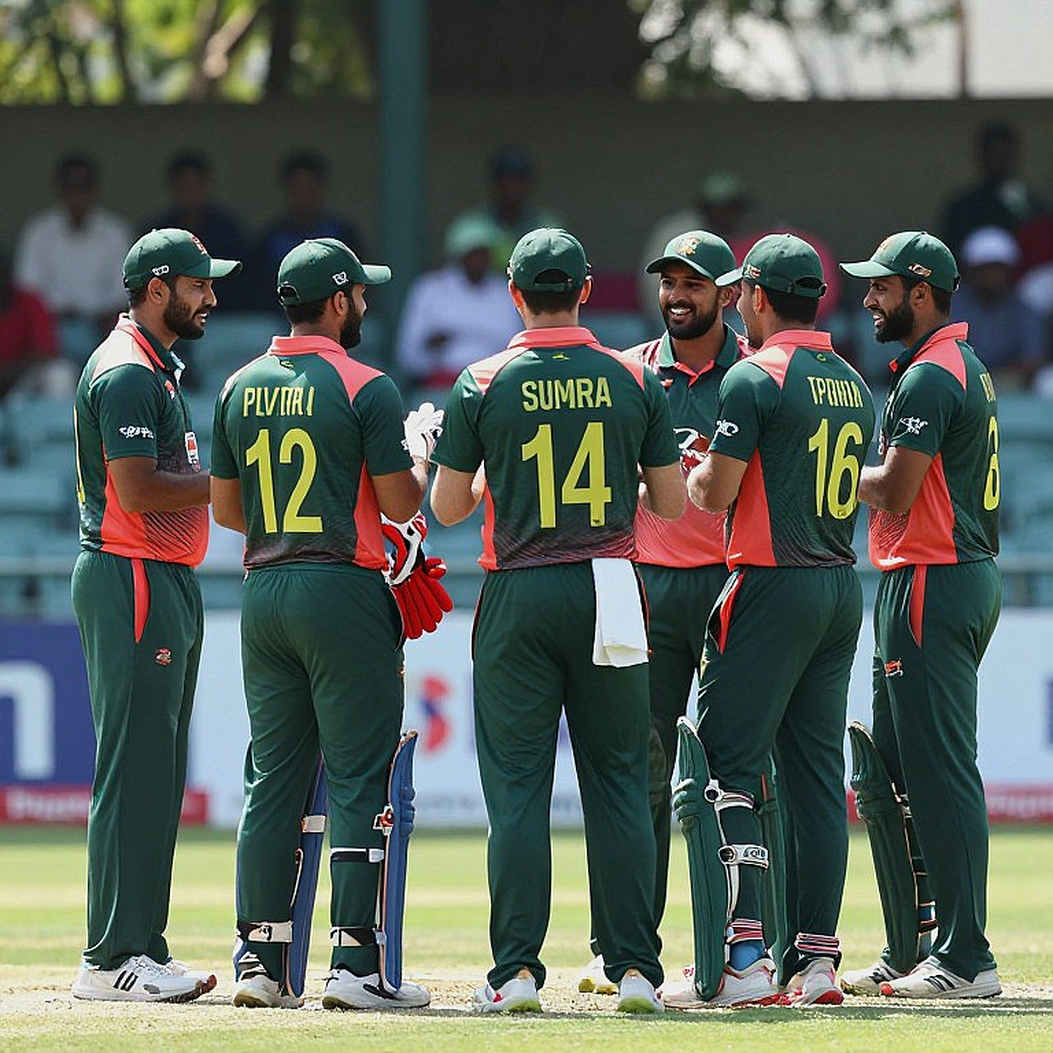
The biggest error at the third rung is assuming T20 experience is 50-over preparation. Nepal, Namibia, Uganda and Canada all played the 2026 T20 World Cup. The entire conversation around Associate cricket over the last two years has been built around T20. This tournament is 50 overs, and the demands differ: a seamer bowls ten overs across four spells, spin has to be controlled through the middle, and runs must be manufactured in the last ten — three separate skills inside one match, one day.
My ledger has three columns: seasonal best, championship history, closing 200 metres. In cricket those columns become recent 50-over record, experience at this level, and execution in the last ten overs under pressure. None of the three has a T20 World Cup column. Sides walking out in Kathmandu on the back of their T20 record are walking into a contest where the game does not end after twenty overs — it begins there.
The bell lap is not the finish; it is where the pattern becomes visible. In a 50-over match the bell lap is the middle overs. This is where the depth of an Associate attack is exposed, because the bowler who sent down four overs in T20 now sends down ten, with nowhere to hide.
The ground: arithmetic of the valley
Both venues sit in the Kathmandu Valley. Altitude, thin air and the dry December weather combine into a surface where spin is worth more and pace is worth less. That favours the home side, whose bowlers see the surface daily while visiting teams see it for the first time.
One variable is unresolved: dew. Humidity is low in Kathmandu in December, but the day-night fixture schedule has not been published. If dew arrives in the second innings, the value of the toss changes and half the arithmetic of home advantage evaporates. I do not publish a preview until four variables are fixed — wind, temperature, crowd and time of day. Two of the four are currently unknown, and that information gap will stay open to the end of this piece.
Four from eight: half a door open, half shut
The field appears to split in two. On one side Namibia, the UAE and Nepal — sides with regular ODI exposure, League 2 experience and boards running something close to professional structures. On the other, Jersey, Kuwait and Italy, for whom this is an experience round. That stratification pre-decides the outcome to a degree.
Only to a degree. Four seats and eight teams produce arithmetic in which one of three "strong" sides can lose a ticket — and that slip will come via net run rate, or via one bad day.
The largest information gap
One thing must be said plainly. The public information around this tournament does not name a single player. No squad lists, no recent form data, no injury reports, no age curves. That is an uncomfortable truth for an analyst: at the individual level I can say nothing, and anything I do say is inference, not analysis. Anyone quoting a batsman's average for this event is quoting something the source material does not contain.
What can be said sits at cohort level. And the most reliable conclusion there is this — the tournament will be decided by format and schedule rather than by personnel. When eight teams play for four seats, the skill gap does not vanish, but its influence contracts and variance expands. Three wickets in one over can rewrite an entire plan.
What has not been decided is the most important thing of all: is this a group stage or a knockout structure? In a group stage the decisive skill is net run rate management; in a knockout it is nerve. Those favour entirely different teams. The side that knows how to play for net run rate can look weak in a knockout, and the reverse holds just as firmly. Without that one piece of information, calling anyone a favourite is an incomplete claim.
The ledger: which row do you cross for free
The World Cup ladder is not a document about merit. It is a document about access. Eight teams qualify automatically, three hosts join them, and the remaining seats are contested by Associates climbing multiple rounds. The asymmetry is visible: for Full Members the first three rungs of the ladder simply do not exist. For an Associate the first rung is League 2, the second is a playoff like Nepal's, the third is the global qualifier. That is why the significance of this event lies not in who wins but in how long the loser must wait.

One more row belongs here: oversight. Anti-corruption monitoring thins out at lower-tier events, and historically the spot-fixing cases have surfaced at exactly this level. No specific concern has been raised about this tournament, but the risk structure is that shape — written here as governance, not as any suggestion of betting.
The buried bigger story
One line in this ledger has drawn almost no attention. The global qualifier will include sides like West Indies and Ireland. A two-time World Cup winner will have to qualify for 2027. What is happening in Kathmandu is the bottom of that ladder, and the top of it is waiting for the team that has lifted the trophy twice.
My vantage should be named. Born in India and working in Britain, I have watched the same hollowing on both sides — the Ranji Trophy and county cricket, each squeezed by the tier above it. Associate cricket is the third instalment of that story, with a thinner balance sheet and fewer spectators. And if West Indies must play a qualifier, the hollowing has reached the top.
The consensus, and its inversion
The consensus is clear and deserves to be stated at full strength: Nepal are hosts, both Kirtipur and Mulpani sit in their valley, the dry December air suits spin, four of eight advance, and the crowd is with them. That reading has weight, and Nepali media will write it exactly that way — the first step at home, towards the World Cup.
I do not invert it for the sake of inversion; I mark its limits. Home advantage is built from three things: familiarity with conditions, crowd pressure, and travel fatigue. The third does not apply here — reaching Kathmandu is a two-day trip for any Associate side, not a five-match tour. The first is real but confined to spin bowling; home surfaces help batsmen far less than is assumed. The second cuts both ways. Kathmandu's crowd plays for its team, and when the first two wickets fall, that same crowd becomes the loudest source of pressure.
The inverted reading, then: Nepal's real examination is not against Italy but against Namibia and the UAE in the middle overs, where they must prove 50-over bowling depth that T20 never asks for.
This reading is wrong if Nepal lose a chase of under 250 in either of their first two matches, or concede above 5.5 an over through the middle — at which point the home-conditions advantage clearly does not travel from spin bowling into batting.
What to watch next
On December 4 the ball will be bowled at Kirtipur and some questions will answer themselves. The most important answer will not arrive there — it sits in the ICC's playing conditions document, where the structure, the tie-breakers and the definition of the "Super Series" are written. Anyone reading this ladder seriously should read that document first, and the Kathmandu scorecard second.
What happens in Kathmandu is one tournament — on a fixed date, in a fixed valley, for a team with nothing to lose and a great deal to prove. Every qualification has a split time, even when nobody is timing it. This time the timers will be in Kathmandu and the watchers scattered worldwide; the gap between those two numbers is the real story.