
French Open 2026 Final: Sindhu's Problem Is Not 0-10, It Is Rally Length
Ten meetings. Ten wins. And this season, both of them in straight games. When...
Ten meetings. Ten wins. And this season, both of them in straight games. When P.V. Sindhu and An Se Young walk into Arena Grand Paris on the morning of 25 October 2026, it will be the eleventh time they have stood across a net from each other — and every preview will lead with the same figure: 0-10.
That is not my first question. My first question is that Sindhu's semi-final lasted 73 minutes, across three games — 21-10, 20-22, 21-16 — against Hina Akechi of Japan, a player nobody ranks in the top tier. An Se Young's semi-final duration appears in no report I have seen. Twenty-four hours before a final, one player's tank carries 73 minutes of rally work and nobody has published the other's ledger. A number that is absent is still information.

This final will not be decided by a skills gap. It will be decided by a cost transfer, and on that accounting An Se Young holds the heavier side of the scale. There is no need to underrate Sindhu; there is a need to recognise the format these two are playing inside, and to measure the twenty-four hours one of them spent in rallies and the other did not disclose.
The structure first. The French Open 2026 is a Super 750 event, and the final is on Sunday, 25 October at 11:00 local — 15:30 IST. One arithmetic detail worth recording: European daylight saving ends on that same Sunday, so Paris is on UTC+1 that morning, which makes 11:00 to 15:30 IST correct. It looks trivial. The preview timelines I have seen go wrong tend to start with exactly that kind of carelessness.
On Sindhu's side: this is her second Super 750 final of the season, and in July she won the Japan Open. At 33, that number matters as much as any title, because it says she is still reaching the last day of Super 750 events. Her current ranking is not stated in any available report, so I will not comment on it.
On the other side stands the world No. 1, aged 24, with six titles from seven tournaments this season. The only player to beat her in 2026 is China's Wang Zhiyi, in March. The list after March runs through four World Tour titles, the World Championships, the Asian Championships and the Asian Games.
One thing needs recording here, because I have promised myself not to print a number that does not reconcile. Six titles from seven events and seven titles since March are both being written about the same season, and they cannot both stand. The ordering of the list is also off: Singapore, Denmark, Indonesia, China Masters — under any normal calendar, Indonesia and Singapore precede Denmark. The same report names the venue three ways: Grand Paris Arena, Arena Grand Paris, and Arena Grand in Paris. One tournament, one hall, three names.
The direction remains clear, and the direction is what matters: in women's singles this season, beating An Se Young is the exception, not the rule. But until the title list and the calendar agree, I will not inflate six-from-seven into something larger. A smaller true sentence beats a larger approximate one — a lesson that came from the 180 words I was allotted for a women's football final in 2026, on a page that carried 900 words on a 110-minute badminton final. Badminton finals now get two thousand words. The question is unchanged: who gets the word budget, and how much verification travels inside it.
The real arithmetic on court is this. Sindhu's game lives on short rallies — a 179 cm reach, a high contact point, a steep and heavy smash. An Se Young's game stretches rallies out — low error, superior retrieval, and now an attack that starts on the first shot. Every additional shot in a rally shifts expected value toward the player who errs less. That is not a skills gap; it is a cost transfer. Sindhu pays a price on every point that An Se Young returns with interest.
Sindhu's scarcity is physical, not tactical invention. Her frame and high contact point give her an angle few on this tour possess — and the same frame sets the price of repeatability at 33. The cost curve of a power-dependent player rises steeply, and across three games it rises fastest. This is not new. Retrieval specialists have been making power hitters expensive over three games for as long as the format has existed.
An Se Young's profile is sustainable at 24. A retrieval-heavy game takes less out of a body than explosive smashing, and it leaves room to improve. That is why her development over the last two seasons has drifted from defence toward attack, and not the other way.
The scoring structure widens the gap further. Twenty-one points, best of three, a two-point margin required — a format that punishes error variance and does not reward peak shot quality. On the day Sindhu's smash is fastest, she still has to keep her error count down to 21. This tournament rewards the player who plays best, not the one who hits hardest. The smallest tactical detail often carries the loudest human question, and here that detail is average rally length, for which nobody has published a figure.
The semi-final scoreline is a fingerprint. Game one at 21-10 says the peak is still available. Game two at 20-22 says something — concentration or hall adjustment — breaks around the sixty-minute mark. Game three at 21-16 with six straight points at the close says the clutch is alive. The plain reading: the peak is available, but it is not holdable beyond sixty minutes. And a player like An Se Young will ask for exactly those sixty minutes.
The dip at 20-22 is the detail I keep returning to. One possibility is drift — the air in Paris halls tends to bite in the second game. If the same drift repeats, expect the same wobble. That is inference, not data, and I will label it as inference.
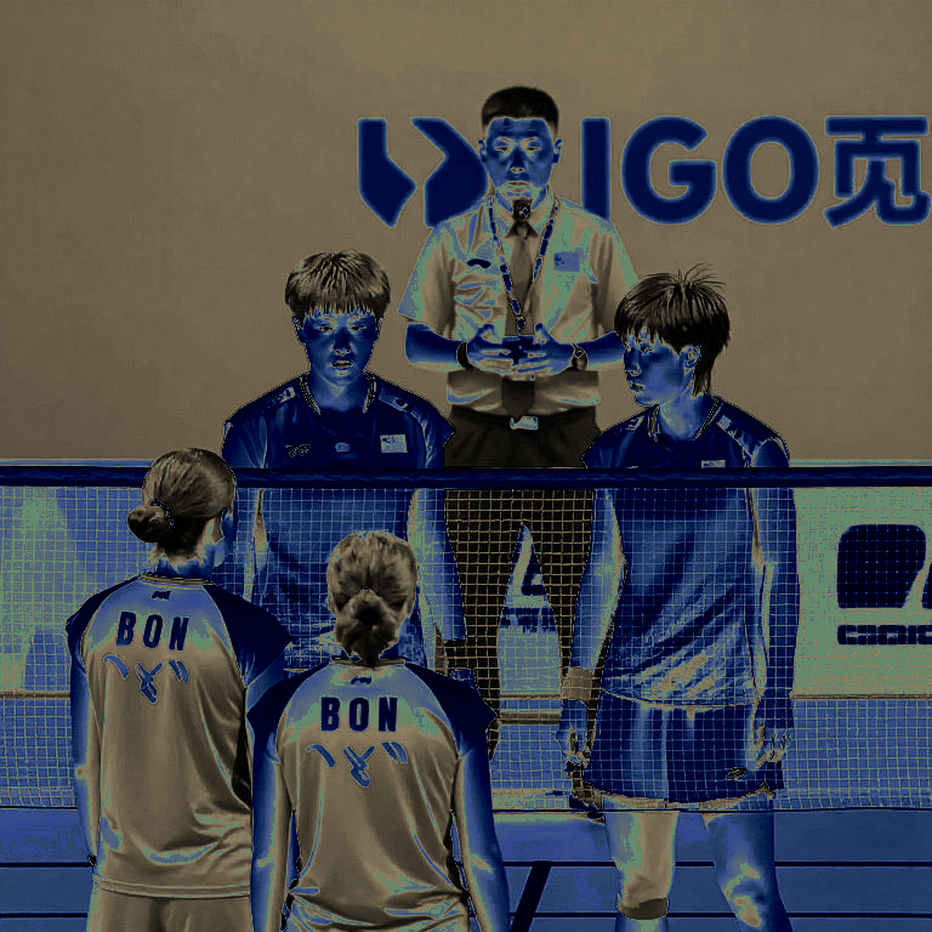
One clarification is necessary, because the previews keep offering it: that Sindhu should draw inspiration from Wang Zhiyi. Wang did beat An Se Young in March, and that fact is the single greatest relief this final has to offer. But inspiration is not a plan. Which length Wang held, which serve pattern she used, how she suppressed the front-court interception — none of it is recorded anywhere. Advice that names no mechanism is a headline, not a forecast.
So what does Sindhu have? Three things. First, front-loaded pressure — high tempo and an attack on the third and fourth shots in game one, so that a lead exists on the scoreboard before rally length settles. Second, nothing-to-lose, which lightens the 0-10 load and can only be spent in the first ten minutes. Third, the 73 minutes she played twenty-four hours earlier — that is fatigue, and it is also match fitness. My inference is that An Se Young will target the backhand rear corner and the body-smash line to stop the steep cross-court angle from forming at all, the oldest prescription against tall attackers. Medium confidence, not certainty.
At every tournament I ask who is not in the room. Missing here: smash speed, average rally length, net win rate, Sindhu's current ranking, and the duration of An Se Young's semi-final. Of the 26 information points behind this preview, 24 carry no named source — no BWF ranking citation, no match statistics, no draw or field data. An empty stand can tell you more than a full one, and the empty space here is in the data, not the stands.
Now the thing most often written wrongly about this final. 0-10 is not evidence of Sindhu's decline; it is evidence of a stylistic pairing in which one player taxes exactly the strength that makes the other dangerous. A second Super 750 final of the season at 33, plus a Japan Open title in July, is not a decline. The decline story is easy because it requires one number and the forgetting of an entire season.
The mirror risk is just as large — the verdict that Sindhu can never beat her. Wang Zhiyi broke that wall in March, so the wall is not impregnable. The question is whether Sindhu possesses the mechanism Wang had, and whether one night is enough time to install it. The tour's real problem with this final is precisely that: high narrative value, low competitive uncertainty. And the tour is selling the shortfall by dressing it as story.
If the format pays for an economy of error, the question moves past Sindhu. Indian badminton's pipeline has spent decades treating the smash as its currency — height, fast hands, steep angles. A player like An Se Young does not accept that currency; she lengthens the rally and changes the coin entirely. Is there room in our academies for the fourteen-year-old who does not hit hardest, only errs least?
On 25 October at 15:30 IST I will be alone in front of a screen, writing for the reader watching alone in the same way. Watch the scoreboard, but watch first whether rally length is rising or falling after game one. If it is rising, the match is already settled — even if the score still reads level. And the question will remain: to beat one player, does Sindhu need to change her whole game, or simply shorten her rallies — and can a rally be shortened in a single night?"